
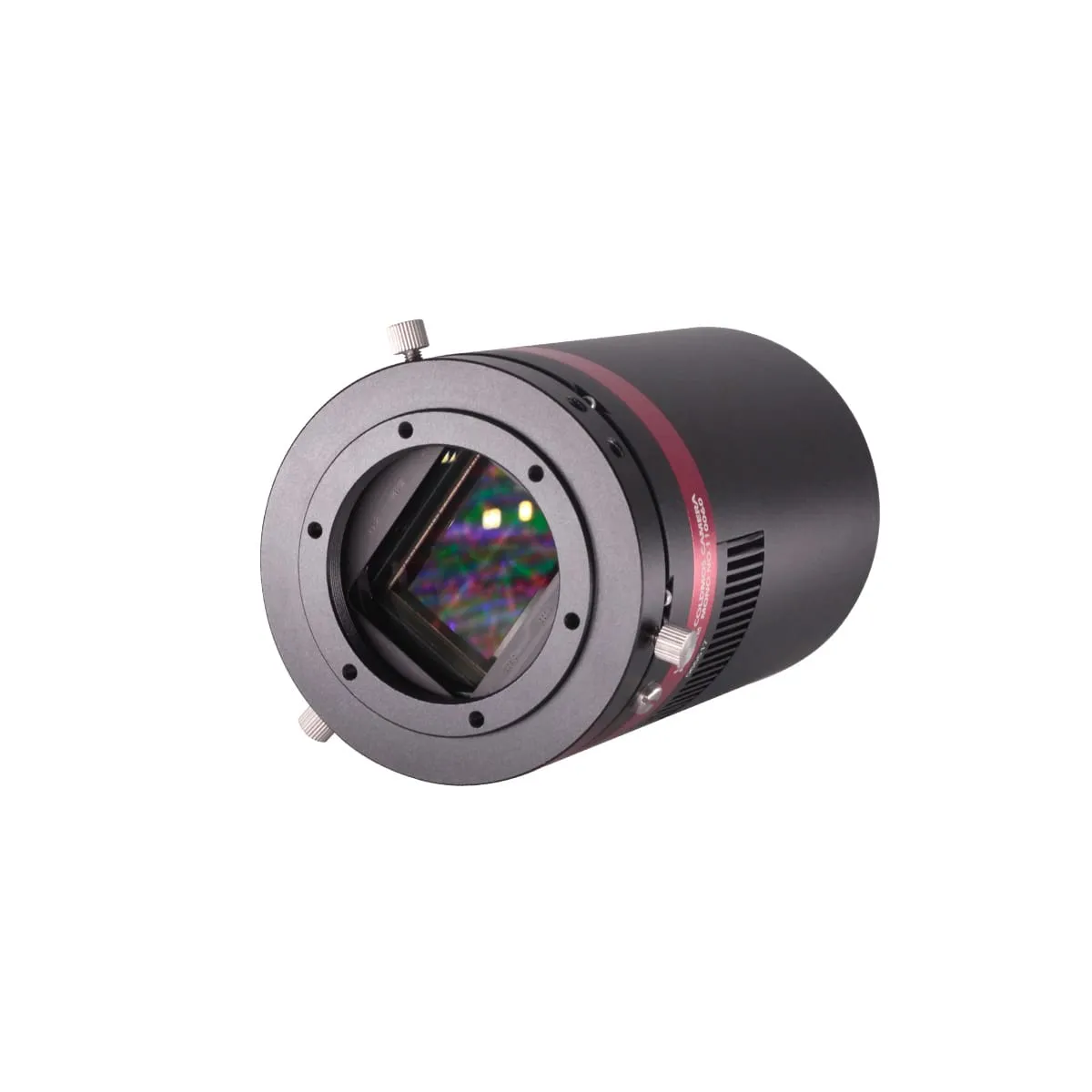
QHY600PH-M Monochrome Cooled Astronomy Camera
- On Back Order
Key Features
- Sony IMX455 Full-Frame Monochrome BSI CMOS Sensor
- 36 × 24 mm Full-Frame Sensor Format ideal for wide-field imaging
- Ultra-Low Read Noise for capturing faint astronomical details
- High Quantum Efficiency Backside-Illuminated Sensor for superior light sensitivity.
- Dual-Stage TEC Cooling System
- Zero Amplifier Glow Technology ensures clean long-exposure images.
- Designed for LRGB and Narrowband Imaging
- Compatible with Professional Telescope Imaging Systems for galaxies, nebulae, and scientific applications.
Description
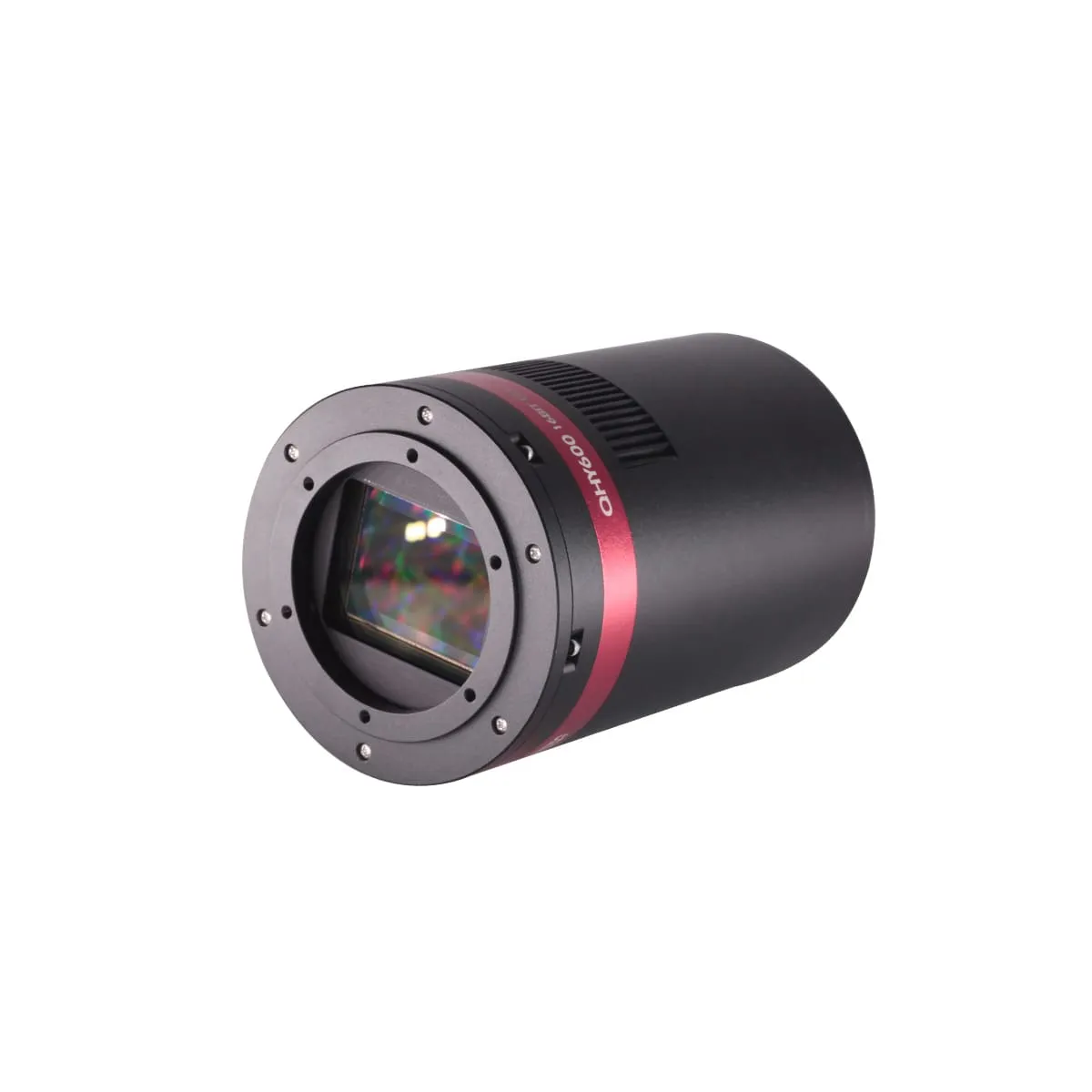
QHY600PH-M Monochrome Cooled Astronomy Camera
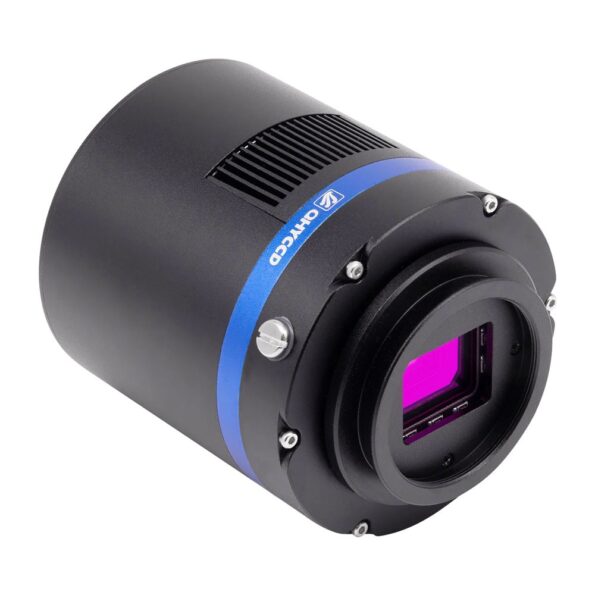
The QHYCCD QHY600PH-M is a professional-grade monochrome cooled astronomy camera designed for high-resolution deep-sky astrophotography. At its heart is the highly sensitive Sony IMX455 back-illuminated (BSI) full-frame CMOS sensor, offering an impressive 61.17 megapixels of resolution in a 36 × 24 mm imaging area.
With 3.76 μm pixels, native 16-bit ADC, extremely low read noise, advanced TEC cooling, and zero amplifier glow, the QHY600PH-M is designed to capture faint astronomical objects with exceptional detail and clean, low-noise images.
Its monochrome sensor also makes it particularly well suited to advanced LRGB and narrowband astrophotography, where individual color or narrowband channels are captured through separate filters and combined during image processing.
Sony IMX455 Full-Frame Monochrome Sensor
The QHY600PH-M uses the Sony IMX455 monochrome BSI CMOS sensor, measuring 36 × 24 mm and providing a resolution of 9576 × 6388 pixels, or approximately 61.17 megapixels.
The large full-frame format provides a wide field of view while the high pixel count allows the camera to record very fine details in galaxies, nebulae, star clusters, and other deep-sky objects.
The sensor's 3.76 μm pixel size provides an excellent balance between resolution and sensitivity, making the camera suitable for a wide range of telescope focal lengths.
Back-Illuminated BSI Technology
The IMX455 uses Back-Side Illumination (BSI) technology. In a BSI sensor, the photosensitive area is positioned to receive incoming light more efficiently, reducing the effect of the circuitry that would otherwise obstruct part of the incoming light.
This design improves photon collection efficiency and contributes to the excellent sensitivity of the IMX455, particularly valuable when imaging faint deep-sky targets.
Monochrome Imaging for Maximum Flexibility
Unlike a one-shot color (OSC) camera, the QHY600PH-M has a monochrome sensor. This means it records luminance information without a built-in Bayer color filter array.
For astrophotographers, this provides much greater flexibility. By using a motorized filter wheel with LRGB filters, separate red, green, blue, and luminance exposures can be captured and combined to produce a detailed full-color image.
The camera is also an excellent choice for narrowband imaging using filters such as H-alpha, OIII, and SII. Narrowband imaging can isolate specific emission wavelengths and reveal extremely subtle structures in nebulae, while also helping reduce the effect of light pollution.
For advanced astrophotography, a monochrome camera such as the QHY600PH-M therefore offers considerably more flexibility than a conventional color camera.
Native 16-Bit ADC
The QHY600PH-M uses a native 16-bit analog-to-digital converter, providing up to 65,536 levels of tonal information.
This high bit depth allows the camera to record very subtle differences in brightness and provides greater flexibility during image processing. It is particularly useful when stretching faint signals from deep-sky exposures without losing delicate tonal information.
The sensor also offers a high full-well capacity, exceeding 51 ke⁻ in standard mode and more than 80 ke⁻ in extended full-well mode, helping the camera capture both faint and relatively bright regions within the same image.
Extremely Low Read Noise
Low read noise is one of the most important characteristics of a modern deep-sky camera. When photographing faint galaxies and nebulae, the astronomical signal can be extremely weak, so minimizing electronic noise is essential.
The QHY600PH-M can achieve read noise as low as approximately 1 electron, depending on the operating mode. This allows very weak signals to be recorded with excellent efficiency.
The sensor also has an exceptionally low dark current. At approximately −20°C, the dark current is around 0.0022 e⁻/pixel/second, helping minimize thermal noise during long exposures.
Dual-Stage TEC Cooling
Long-exposure astrophotography generates thermal noise, especially when the camera is operated under warm ambient conditions. The QHY600PH-M addresses this with an advanced dual-stage thermoelectric (TEC) cooling system.
The cooling system can reduce the sensor temperature by up to approximately 35°C below ambient temperature, depending on environmental conditions.
By maintaining a stable and low sensor temperature, the camera reduces dark current and thermal noise and provides more consistent results between exposures. This is particularly important when creating calibration frames such as dark frames and bias frames.
Zero Amplifier Glow
Another important feature is Zero Amplifier Glow technology.
Amplifier glow can appear in some CMOS cameras during long exposures as unwanted bright areas caused by heat or electrical activity around the sensor's amplifier circuitry.
The QHY600PH-M is designed to eliminate amplifier glow, helping produce cleaner long-exposure images and making the camera particularly suitable for deep-sky imaging.
2GB DDR3 Image Buffer
The camera incorporates 2GB of DDR3 buffer memory to help manage the large amount of data generated by its 61-megapixel sensor.
This large internal buffer helps maintain stable image transfer and reduces the possibility of dropped frames during high-speed operation.
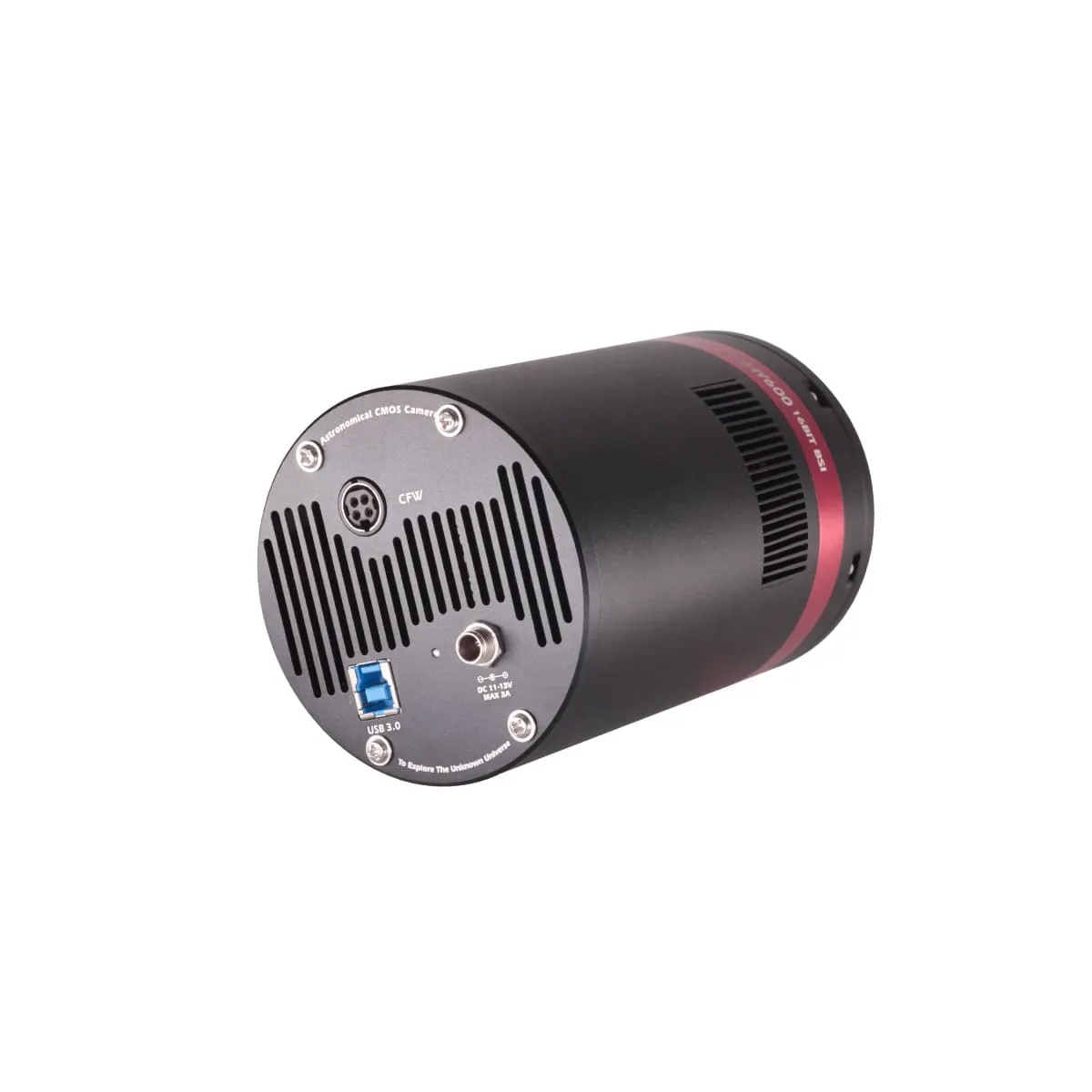
Images are transferred through a USB 3.0 interface, providing the bandwidth required to handle the camera's large high-resolution image files.
Advanced Readout Modes
The QHY600PH-M incorporates QHYCCD's 2CMS readout technology, providing different operating modes that allow the user to optimize the camera for different imaging requirements.
Depending on the selected mode, the user can prioritize characteristics such as lower read noise, higher dynamic range, or increased sensitivity.
This flexibility allows the camera to be optimized for different targets and exposure strategies rather than forcing every type of imaging into a single operating mode.
Anti-Dew Protection
The camera includes a built-in anti-dew heater around the optical window to help prevent condensation from forming during cold and humid observing sessions.
This is particularly useful for long unattended imaging sessions, where dew formation on the optical window could otherwise ruin an imaging sequence.
The optical window also uses AR+AR anti-reflection coatings, which help improve light transmission and reduce unwanted reflections.
Ideal for LRGB and Narrowband Astrophotography
The QHY600PH-M is particularly powerful when combined with a motorized filter wheel and a suitable set of astronomical filters.
For LRGB imaging, the photographer can capture separate luminance, red, green, and blue exposures and combine them in image-processing software to produce a high-resolution color image.
For narrowband imaging, filters such as H-alpha, OIII, and SII can isolate specific emission wavelengths from nebulae. This makes it possible to reveal structures and details that can be difficult to capture with conventional broadband color imaging.
The monochrome sensor is therefore an excellent platform for serious astrophotographers who want complete control over their imaging workflow.
What Is the QHY600PH-M Designed For?
The QHY600PH-M is primarily designed for advanced deep-sky astrophotography. Its combination of a large full-frame sensor, high resolution, low noise, active cooling, and monochrome imaging makes it particularly suitable for:
- Galaxies
- Emission nebulae
- Reflection nebulae
- Planetary nebulae
- Star clusters
- LRGB astrophotography
- Narrowband astrophotography
- High-resolution wide-field imaging
- Photometric and other advanced astronomical imaging applications
The large 36 × 24 mm sensor is especially useful when a wide field of view is required, while its 61.17-megapixel resolution provides plenty of detail for demanding imaging projects.
Who Should Buy the QHY600PH-M?
The QHY600PH-M is aimed at experienced astrophotographers and advanced enthusiasts rather than beginners.
It is an excellent choice for someone who already has, or is planning to build, a serious deep-sky imaging system consisting of a suitable telescope, accurate equatorial mount, filter wheel, and LRGB or narrowband filters.
It is particularly well suited to photographers who want to move beyond a simple one-shot-color camera and gain full control over individual imaging channels.
The camera can also be an excellent upgrade for an experienced astrophotographer who wants a larger full-frame sensor, higher resolution, lower noise, and greater flexibility for advanced image processing.
However, if you are just starting astrophotography and want a simple setup that produces color images without a filter wheel and multiple filters, a cooled color astronomy camera may be a more convenient choice.
A Professional Foundation for Deep-Sky Imaging
The QHYCCD QHY600PH-M combines the capabilities of the Sony IMX455 full-frame sensor with QHYCCD's advanced cooling and camera electronics to create a highly capable platform for serious astronomical imaging.
Its 61.17MP monochrome BSI sensor, 3.76 μm pixels, native 16-bit ADC, extremely low read noise, high quantum efficiency, dual-stage TEC cooling, zero amplifier glow, and 2GB DDR3 buffer make it particularly well suited to demanding long-exposure astrophotography.
For astrophotographers who want maximum flexibility and intend to build a professional LRGB or narrowband imaging system, the QHY600PH-M is a powerful and highly capable choice.
| Specification | Details |
|---|---|
| Sensor | Sony IMX455 Monochrome CMOS |
| Sensor Type | BSI CMOS |
| Sensor Size | 36 × 24 mm |
| Resolution | 9576 × 6388 pixels |
| Megapixels | 61 MP |
| Pixel Size | 3.76 μm |
| Bit Depth | 16-bit |
| Quantum Efficiency | Up to 87% |
| Read Noise | 1.0–3.7 e⁻ |
| Full-Well Capacity | >51,000 e⁻ |
| Dark Current | 0.0022 e⁻/pixel/s |
| Cooling | Active TEC Cooling |
| Maximum Cooling | Up to 35°C below ambient |
| Maximum Exposure | 60 minutes |
| Minimum Exposure | 40 μs |
| Frame Rate | 2.5 fps at full resolution |
| Shutter | Rolling Shutter |
| Internal Memory | 2 GB DDR3 |
| Interface | USB 3.0 |
| Telescope Connection | M54 |
| Flange Focal Distance | 17.5 mm + 6 mm (CAA) |
| Power Supply | 12 V DC (Not included) |
| Power Cable Length | 1.5 m |
| Color | Monochrome |
| Filter Wheel | Not included |
| Weight | 780 g |
| Dimensions (Diameter × Length) | 90 × 141 mm |
| Series | QHY600 |
| Type | Astronomical Camera |
| Autoguiding | No |
| Moon & Planetary Imaging | Yes |
| Nebulae & Galaxy Imaging | Yes |
| All-Sky & Meteor Imaging | Yes |
Key Features of QHYCCD QHY600PH-M Monochrome Cooled Astronomy Camera
- Sony IMX455 Full-Frame Monochrome BSI CMOS Sensor with 61.17 megapixels for ultra-high-resolution astrophotography.
- 36 × 24 mm Full-Frame Sensor Format ideal for wide-field imaging and professional deep-sky photography.
- 3.76 μm Pixel Size provides an excellent balance between resolution and sensitivity.
- Native 16-bit ADC delivers 65,536 levels of grayscale for smooth image processing.
- Ultra-Low Read Noise (down to approximately 1 e⁻) for capturing faint astronomical details.
- High Quantum Efficiency Backside-Illuminated Sensor for superior light sensitivity.
- Dual-Stage TEC Cooling System lowers sensor temperature up to approximately 35°C below ambient.
- Zero Amplifier Glow Technology ensures clean long-exposure images.
- 2GB DDR3 Buffer Memory enables stable high-speed image transfer.
- Advanced 2CMS Readout Modes optimize performance for different imaging conditions.
- USB 3.0 Interface for fast data transmission.
- Built-In Anti-Dew Heater prevents condensation on the optical window.
- High-Quality Multi-Layer Anti-Reflection (AR) Coated Optical Window
- Designed for LRGB and Narrowband Imaging when paired with a motorized filter wheel.
- Compatible with Professional Telescope Imaging Systems for galaxies, nebulae, and scientific applications.
Important Note:
QHY600PH Series has four Models. The four models are actually the same QHY600PH camera platform (Sony IMX455, 61MP full-frame sensor). The differences are only sensor type (mono/color) and back focal length.
QHY600PH Series Models
| Model | Main Difference | Back Focal Length |
|---|---|---|
| QHY600PH-M | Monochrome version with the standard body/back-focus configuration. | 17.5 mm + 6 mm (CAA) |
| QHY600PH-C | Color (OSC) version with the standard body/back-focus configuration. | 17.5 mm + 6 mm (CAA) |
| QHY600PH-M SBFL | Monochrome version with Short Back Focal Length, designed for systems with limited back focus and DSLR lenses. | 14.5 mm ± 0.2 mm |
| QHY600PH-C SBFL | Color (OSC) version with Short Back Focal Length, designed for systems with limited back focus and DSLR lenses. | 14.5 mm ± 0.2 mm |
In simple terms:
- M = Monochrome
- C = Color
- SBFL = Short Back Focal Length
- Standard = 17.5 + 6 mm (CAA)
- SBFL = 14.5 mm
QHYCCD specifically says the SBFL versions are designed for DSLR lens users and systems requiring a shorter back focal length. They can also be used with Canon/Nikon lenses even when a filter wheel is installed.
Reviews
Recommended

0.0 Average Rating Rated (0 Reviews)