


Understanding Infinity Optics, Real-World Performance, and Why This Microscope Stands Out
The modern microscope market is filled with products that appear similar at first glance. Many microscopes offer LED illumination, mechanical stages, trinocular heads, and magnification ranges extending to 1000x or beyond. Yet experienced microscopists know that the true difference between microscopes is not found in marketing specifications alone. The real distinction lies in optical design, mechanical precision, expandability, image quality, and long-term usability.
The BRESSER Science Infinity Microscope is one of those microscopes that becomes more interesting the deeper you examine its design philosophy. At first glance, it appears to be a professional trinocular biological microscope aimed at educational and laboratory users. However, beneath its relatively accessible price point lies a feature usually associated with significantly more expensive scientific instruments: an infinity-corrected optical system.
For many buyers, the term “Infinity Optics” may sound like technical marketing language. In reality, it represents one of the most important developments in modern microscopy. Understanding what this system does — and why it matters — helps explain why this microscope attracts attention from advanced hobbyists, educational laboratories, and even experienced users familiar with high-end professional instruments.
This article takes a detailed look at the BRESSER Science Infinity Microscope from both a technical and practical perspective. Rather than simply repeating specifications, we will examine how the microscope performs in real-world use, why its design matters, and what kind of user can benefit most from it.
Introduction: A Professional-Style Microscope at an Accessible Price
For decades, serious microscopy was dominated by manufacturers such as Carl Zeiss, Nikon, Leica Microsystems, and Olympus Corporation. Their instruments became standard equipment in universities, hospitals, and scientific laboratories worldwide. These microscopes are exceptional, but they are also expensive. Even older used laboratory microscopes from these brands often remain costly because of their optical quality and long service life.
In recent years, Chinese manufacturing has changed the microscope market significantly. Companies can now produce microscopes with surprisingly good optical quality at much lower prices than traditional European or Japanese systems. Naturally, not all models are equal, and some low-cost microscopes still suffer from poor optics or weak mechanics. However, certain models have managed to offer an impressive balance between price and performance. The BRESSER Science Infinity Microscope belongs to this category. Although the microscope is marketed under the German BRESSER brand, its production is based in China. For some buyers, this immediately raises questions about quality. Yet modern Chinese optical manufacturing has improved enormously over the past two decades. Today, many optical systems — including products sold under major international brands — are manufactured or assembled in China.
What matters is not simply where the microscope is made, but how well it is designed, assembled, and engineered.
In practical use, the BRESSER Science Infinity Microscope feels much closer to a true laboratory microscope than to a consumer educational model. Its weight, focusing system, optical clarity, and trinocular design immediately separate it from inexpensive beginner microscopes.
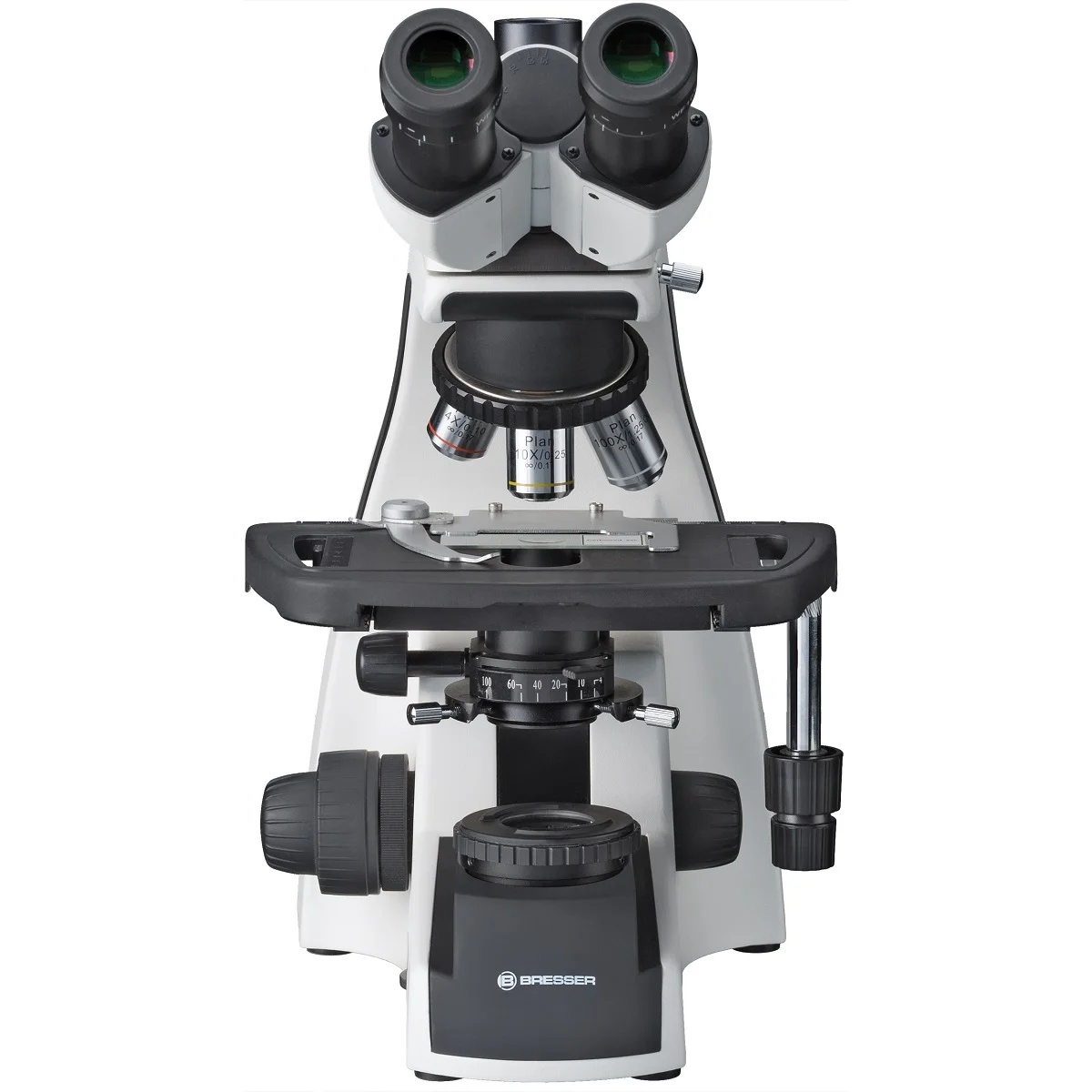
The defining feature of this microscope is its infinity-corrected optical system. To understand why this matters, we first need to understand how traditional microscopes work.
Traditional Finite Optical Systems, Why Infinity Optics Matter
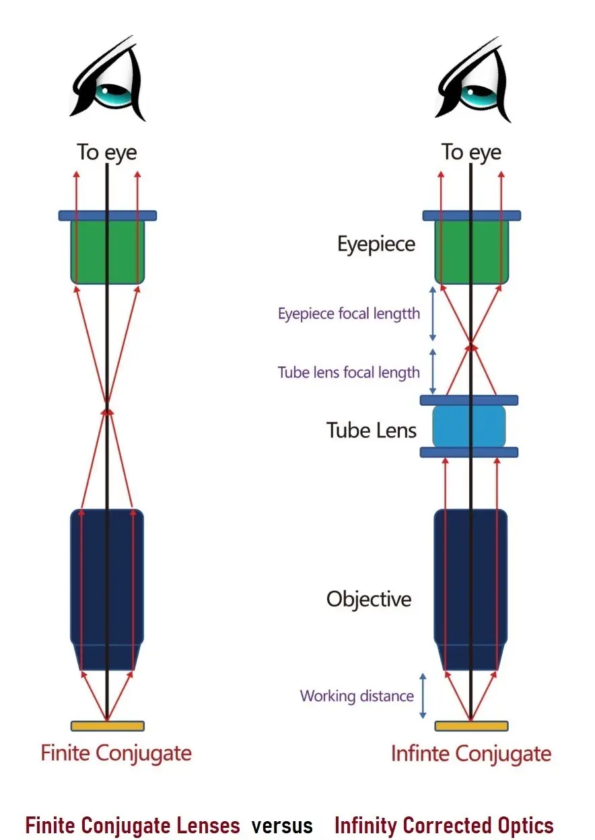
Most older inexpensive microscopes use what is known as a finite optical system. In this design, the objective lens creates a focused image at a fixed physical distance within the microscope body — 160 mm or 170 mm depending on the standards. The eyepiece then magnifies this image for viewing. This design works well and has been used successfully for decades. Many excellent microscopes were built using finite optics. However, the system has an important limitation:
The optical path between the objective lens and eyepiece must remain fixed and unobstructed. If additional optical components are inserted into the light path — such as filters, beam splitters, polarizers, fluorescence accessories, or imaging systems — image quality can degrade and focus accuracy may be affected. For basic observation, this limitation is usually not important. But for advanced microscopy, it becomes a major restriction.
| Feature | Finite Optical System | Infinity-Corrected Optical System |
| Image Formation | Objective lens forms the image directly at a fixed distance inside the microscope body | Objective lens projects parallel light rays that are later focused by a tube lens |
| Typical Tube Length | Fixed mechanical tube length (usually 160 mm or 170 mm) | No fixed image distance between objective and eyepiece |
| Objective Marking | Usually marked with numbers such as “160” or “170” | Usually marked with the infinity symbol “∞” |
| Tube Lens Requirement | Does not require a tube lens | Requires an internal tube lens |
| Optical Flexibility | Limited | Highly flexible and modular |
| Ability to Add Filters and Optical Accessories | Very limited — adding accessories can disturb focus and image quality | Excellent — accessories can be added into the parallel light path with minimal optical impact |
| Compatibility with Modern Imaging Systems | More restrictive | Well suited for digital cameras and advanced imaging |
| Expandability | Limited upgrade possibilities | Easily expandable with advanced accessories |
| Support for Polarization, Fluorescence, Phase Contrast, etc. | Often difficult or impractical | Designed for advanced microscopy techniques |
| Image Stability After Modifications | Optical performance can degrade when accessories are added | Maintains image quality more effectively |
| Optical Complexity | Simpler design | More advanced optical architecture |
| Typical Applications | Educational microscopes, student microscopes, older laboratory systems | Modern laboratory, research, educational, and professional microscopes |
| Common Price Range | Usually lower cost | Typically more expensive |
| Long-Term Upgrade Potential | Limited | Excellent |
| Typical Users | Beginners, schools, casual users | Researchers, universities, advanced enthusiasts, laboratories |
| Examples | Traditional DIN/JIS microscopes | BRESSER Science Infinity Microscope, Nikon Eclipse Ti2, Zeiss Axioscope |
The Infinity-Corrected Optical System Explained
In an infinity-corrected system, the objective lens does not create the final image directly. Instead, the objective projects parallel light rays that are effectively focused “at infinity.” A second optical element inside the microscope body — called the tube lens — then focuses these rays into the final image viewed through the eyepieces or captured by a camera. This design creates an important advantage:
There is space between the objective lens and the tube lens where additional optical accessories can be inserted without significantly affecting image quality. This makes infinity systems far more flexible and modular than finite systems. Modern research microscopes almost universally use infinity optics because they support advanced imaging techniques and allow much greater expandability.
Why This Matters in Real Use
For many casual users, infinity optics may initially seem unnecessary. If someone only plans to observe prepared slides occasionally, a finite microscope may be perfectly adequate. However, users often become more ambitious over time.
A microscope owner may eventually want to:
- Add a digital microscope camera
- Use polarizing filters
- Experiment with dark-field illumination
- Try Rheinberg illumination
- Upgrade to phase contrast
- Explore fluorescence microscopy
- Insert beam splitters or measurement accessories
Finite systems become restrictive very quickly when users begin exploring these techniques. The BRESSER Science Infinity Microscope is attractive because it gives users access to a more professional optical architecture without the extremely high cost normally associated with infinity systems.
Optical Performance in Real-World Observation
Specifications alone do not determine whether a microscope is enjoyable to use. Real-world image quality matters far more. Fortunately, the BRESSER Science Infinity Microscope performs impressively in practical observation. The microscope offers magnification from 40x to 1000x, covering the standard biological observation range used in laboratories and educational environments.
Lower Magnifications
At lower magnifications such as 40x and 100x, the microscope provides wide-field viewing ideal for:
- Scanning prepared slides
- Observing plant structures
- Examining insect anatomy
- Locating microorganisms
- Viewing tissue organization
The image appears bright and evenly illuminated, with good contrast across the viewing field.
Medium Magnifications
At 400x magnification, the microscope becomes capable of serious biological observation.
Users can observe:
- Cellular structures
- Protozoa
- Algae
- Blood cells
- Fine plant tissue details
- Pond water microorganisms
The plan achromatic objectives help maintain image flatness across the field of view. This is important because lower-quality objectives often produce sharp focus only at the center while edges become blurry. Here, the field remains relatively flat and comfortable for observation. Chromatic aberration is also well controlled, meaning colored fringes around specimens are minimal.
High Magnification Performance
At 1000x magnification using oil immersion, image quality naturally becomes more demanding. This is where cheaper microscopes often begin to struggle. The BRESSER Infinity microscope performs surprisingly well considering its price category. Fine focus adjustments remain smooth enough for careful observation of microorganisms and detailed biological structures. While the highest-magnification objective may not fully match the optical perfection of premium research systems that cost many times more, its performance remains highly usable and scientifically valuable. Careful condenser adjustment significantly improves contrast and detail at high power and rids you of the need to go astronomical on your professional microscope purchase!
What Is Köhler Illumination?
Another important strength of the microscope is its illumination system. The microscope uses dimmable LED transmitted illumination combined with Köhler-style illumination principles.
Köhler illumination is considered the standard illumination method in serious microscopy. Rather than simply flooding the specimen with light, Köhler illumination carefully aligns and distributes light evenly across the field of view.
The advantages include:
- Improved contrast
- Better sharpness
- Reduced glare
- Uniform brightness
- More accurate specimen detail
Once properly adjusted, the illumination feels professional and controlled rather than harsh or uneven.
Advantages of LED Illumination
Modern LED illumination offers several practical benefits over older halogen systems:
- Lower heat generation
- Longer lifespan
- Reduced power consumption
- Stable brightness
- Consistent color temperature
- Minimal maintenance
The brightness adjustment range is especially useful. Delicate transparent specimens often require softer illumination, while denser or highly magnified specimens benefit from stronger light intensity. One particularly interesting aspect noted by experienced users is that the LED module design appears relatively accessible and modifiable. This potentially allows advanced users to experiment with alternative illumination wavelengths such as ultraviolet LEDs for fluorescence-related applications. While such modifications are obviously intended for advanced users only, the microscope's design permits this level of experimentation, demonstrating the system's flexibility.
Build Quality and Mechanical Design
The microscope body combines aluminum and engineered plastic construction. With a weight approaching 7 kilograms, the microscope feels stable and substantial on the laboratory bench. This stability becomes important during high-magnification observation because vibrations can significantly affect image clarity. The overall impression is not that of a fragile educational microscope, but rather a true laboratory instrument designed for regular use.
Focusing System
The coarse and fine focusing controls operate smoothly and predictably. At high magnifications, precise focusing becomes critically important because depth of field becomes extremely shallow. The fine focus mechanism allows extremely small adjustments without sudden movement or instability. Interestingly, users familiar with expensive professional microscopes have commented positively on the focusing quality considering the price category.
Mechanical Stage Performance
The high-end XY mechanical stage is another strong feature. At low magnifications, manual slide movement is easy even without a mechanical stage. But at 400x or 1000x magnification, even tiny movements dramatically shift the image. The precision mechanical stage allows controlled movement in both X and Y directions using ergonomic controls.
This becomes essential when:
- Scanning large specimens
- Tracking moving microorganisms
- Performing image capture
- Comparing specimen regions
- Conducting educational demonstrations
The single-hand operation design is particularly comfortable during prolonged use.
Expandability and Future Upgrades
One of the strongest reasons to choose an infinity microscope is future expandability. Many users begin microscopy casually but gradually become interested in advanced observation techniques. The BRESSER Infinity microscope supports this progression well. Potential upgrades and accessories may include:
- Digital microscope cameras
- Polarization systems
- Dark-field condensers
- Phase contrast systems
- Additional filters
- Fluorescence experimentation
- Beam splitters
This expandability makes the microscope feel more like a long-term platform rather than a limited beginner instrument.
Camera Compatibility and Digital Imaging
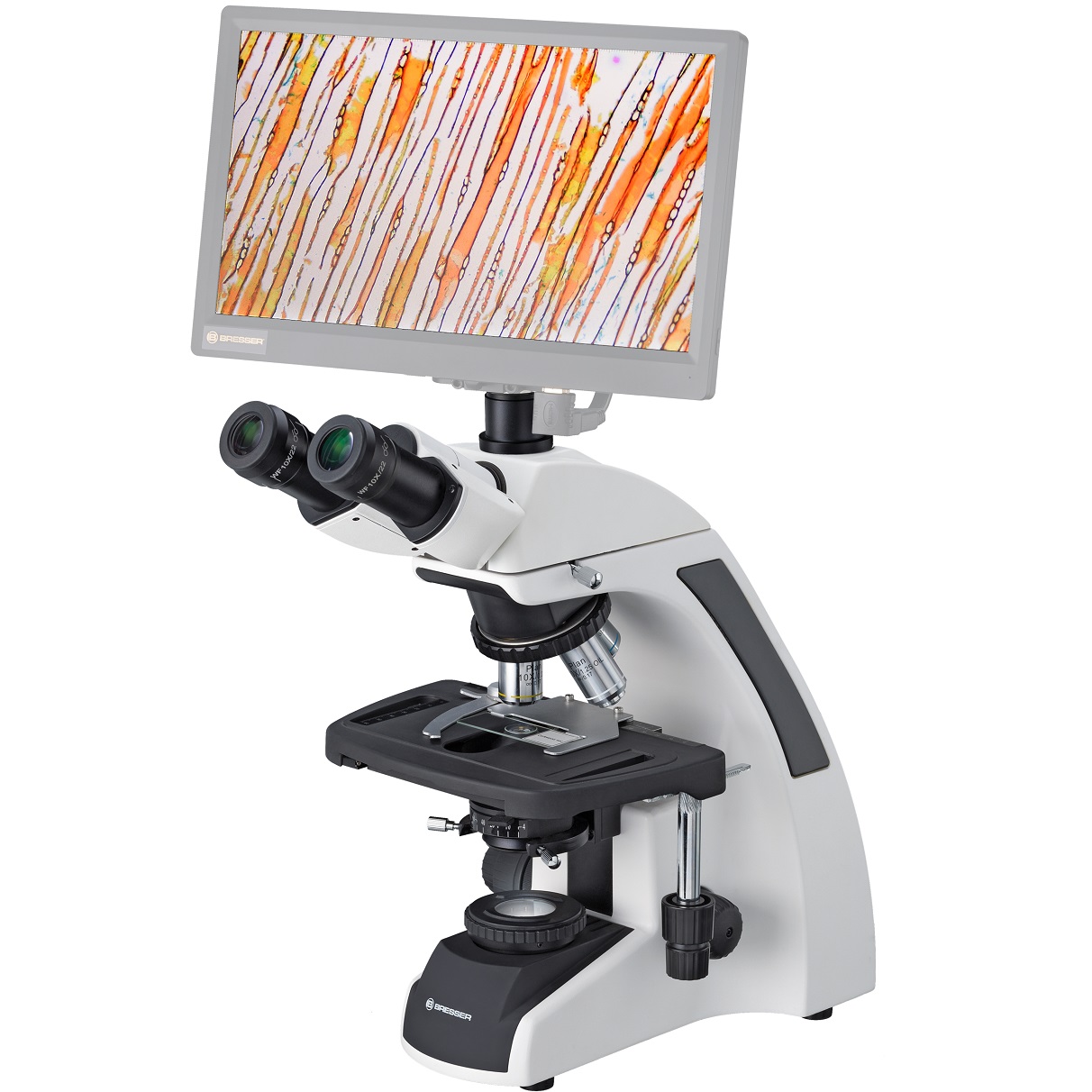
The trinocular head is extremely valuable for modern microscopy. Digital imaging has become an essential part of scientific observation, education, and online content creation. The dedicated camera port allows users to attach a microscope camera without sacrificing binocular observation capability.
This is particularly useful for:
- Classroom teaching
- Scientific documentation
- Sharing observations online
- Recording videos
- Live monitor display
- Research archiving
For educational institutions and advanced hobbyists alike, the trinocular design greatly increases the microscope’s usefulness.
Real-World User Experience
One of the most interesting aspects of this microscope is how experienced users react to it. People who have spent decades using professional microscopes are often skeptical of moderately priced systems. Many inexpensive microscopes appear impressive in specifications but disappoint in practical use.
The BRESSER Science Infinity Microscope seems to avoid many of these disappointments.
Users frequently comment positively on:
- Image clarity
- Wide field of view
- Optical sharpness
- Smooth focusing
- Good illumination control
- Upgrade flexibility
- Strong overall value
This does not mean the microscope is identical to extremely expensive research systems from Zeiss or Nikon. It is not. However, the important point is that it delivers a surprisingly professional experience for its price category.

Minor Limitations
No microscope is perfect, especially at this price level. There are a few small compromises. Some mechanical components are not finished to the same level as ultra-premium research microscopes. Certain adjustments may feel slightly less refined compared to systems costing several times more. The condenser filter holder could also be designed more conveniently for frequent filter changes. However, these issues are relatively minor and do not significantly reduce the microscope’s practical usability. Most importantly, the core optical performance — the area that matters most — remains strong.
Who Is This Microscope For?
The BRESSER Science Infinity Microscope is especially suitable for:
- Professional and Advanced amateur microscopists
- Biology students
- Universities and schools
- Educational laboratories
- Research environments
- Science educators
- Digital microscopy users
- Hobbyists interested in advanced illumination techniques
- Users seeking future expandability
It is particularly attractive for users who want a microscope capable of growing alongside their interests.
Final Verdict
The BRESSER Science Infinity Microscope occupies an interesting and valuable position in the microscope market.
It is not merely an entry-level educational microscope with inflated marketing claims. Nor is it an ultra-expensive research instrument restricted to professional laboratories. Instead, it successfully bridges the gap between affordability and professional functionality. Its infinity-corrected optical system gives users access to a more advanced and modular style of microscopy typically associated with significantly more expensive instruments. Combined with good optical quality, a stable mechanical design, LED Köhler-style illumination, and trinocular camera compatibility, the microscope offers a genuinely capable platform for serious biological observation. Perhaps the most important compliment that can be given to this microscope is this:
Experienced microscopists who are accustomed to using high-end professional equipment often find themselves pleasantly surprised by how capable and enjoyable it is to use. For students, educators, advanced hobbyists, and laboratories seeking strong performance without entering the price range of premium research brands, the BRESSER Science Infinity Microscope represents one of the more compelling options currently available.



No Comments