

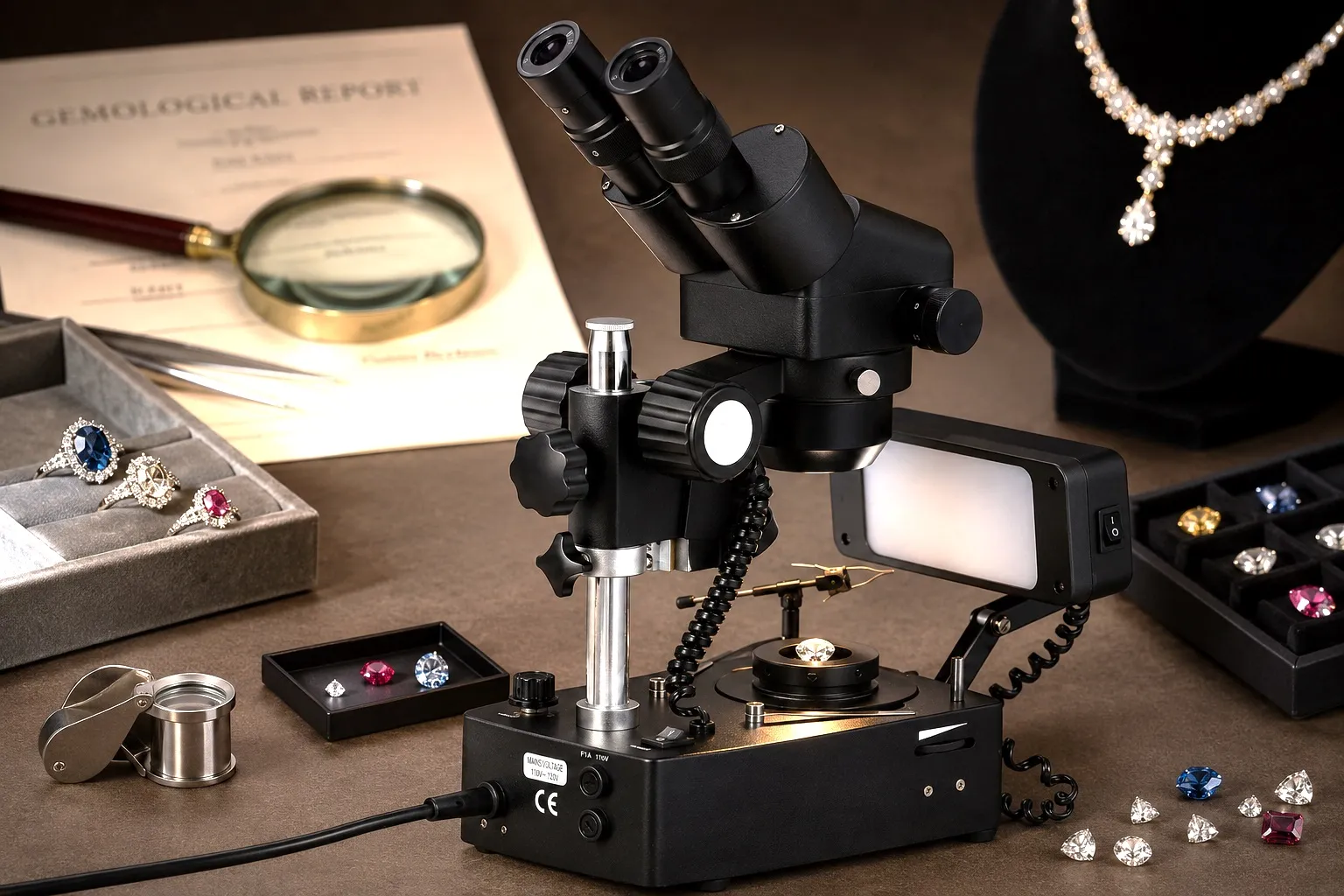
AmScope SH-2 Series Jewelry Gem Stereo Microscope 10X–40X Review
A Specialized Stereo Microscope for Gemstones, Jewelry Inspection, and Precision Observation
For thousands of years, humans have been fascinated by gemstones. Long before modern science understood crystal structures, refractive indexes, or optical dispersion, gemstones were already symbols of wealth, power, spirituality, and craftsmanship. Ancient Egyptians polished turquoise and lapis lazuli into ceremonial jewelry. Roman merchants traded emeralds and sapphires across continents. In Persia and India, precious stones were associated with astronomy, medicine, and royal authority. Diamonds themselves were once believed to possess mystical protective powers. Yet throughout most of history, gemstone inspection depended entirely on the naked eye.
Jewelry experts learned to evaluate stones using experience, lighting conditions, and simple magnifying lenses. The jeweler’s loupe — still widely used today — became one of the earliest specialized optical tools for gem examination. Even now, many gemologists carry a 10x loupe as an essential instrument.
But modern gemstone evaluation demands much more than a handheld magnifier can comfortably provide. Tiny inclusions, surface fractures, polishing marks, facet imperfections, repair traces, synthetic growth structures, and microscopic contamination often require stable stereoscopic observation under controlled lighting. This is where stereo microscopes became revolutionary tools in jewelry and gemological work.
The AmScope SH-2 Series Jewelry Gem Stereo Microscope 10X-40X belongs to this specialized category of instruments. Unlike general-purpose stereo microscopes designed mainly for education or electronics repair, the SH-2 series is clearly optimized for gemstone and jewelry inspection. Its magnification range, stereo optical system, gemstone clamp, darkfield illumination, and ergonomic design all reflect the practical needs of jewelers, gemologists, watchmakers, collectors, and precision inspectors.
This article explores not only the microscope itself, but also the fascinating role stereo microscopy plays in modern gemstone observation and jewelry craftsmanship.
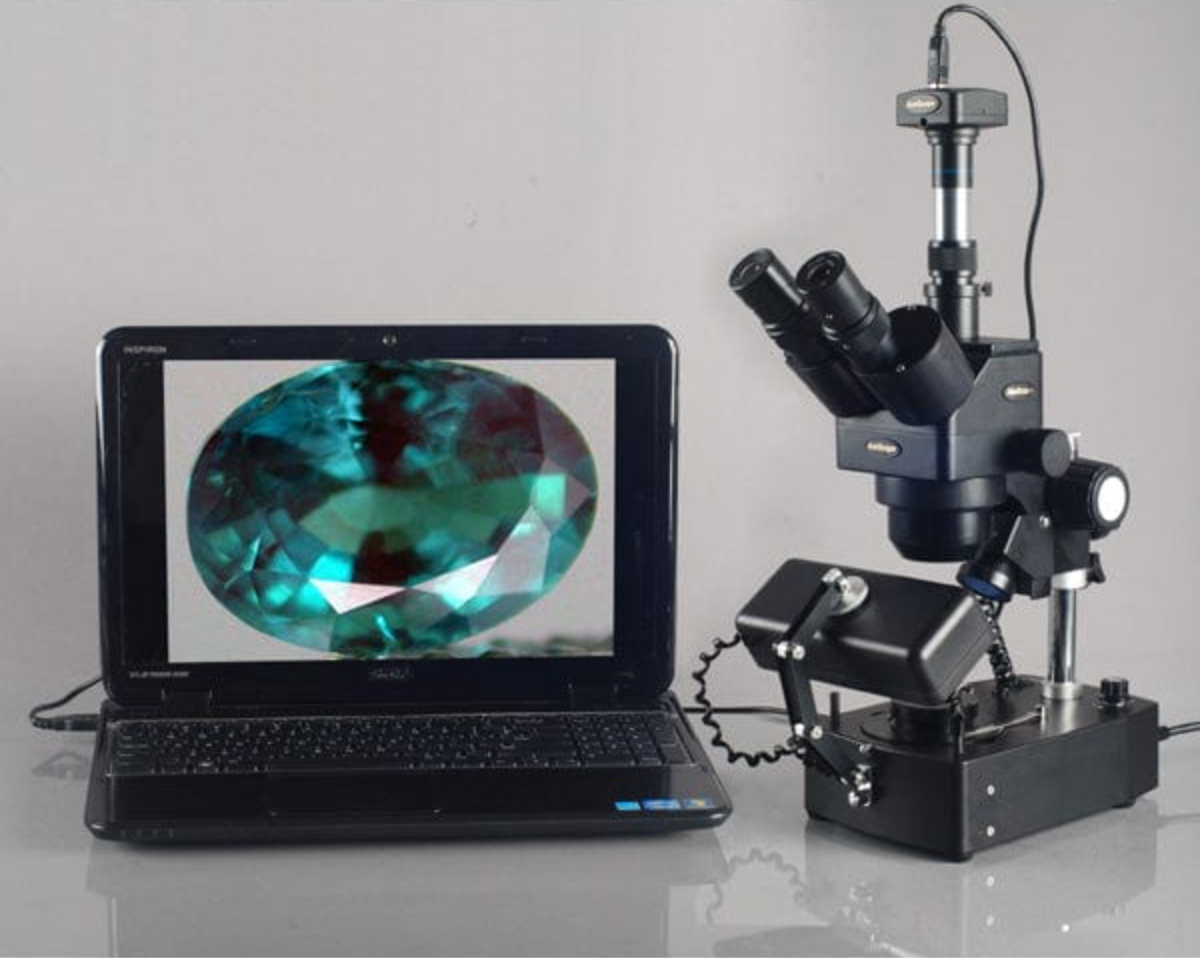
The Evolution of Gem Inspection
The history of gem inspection is deeply connected to the evolution of optics. For centuries, jewelers relied on candles, sunlight, polished mirrors, and handheld lenses to evaluate gemstones. Skilled craftsmen learned to recognize brilliance, color consistency, and inclusions through experience alone. However, as gem trading expanded globally during the 18th and 19th centuries, more precise inspection methods became necessary. The invention of precision optical lenses changed everything.
Magnifiers allowed jewelers to identify:
- natural inclusions,
- polishing defects,
- fractures,
- imitation stones,
- and signs of treatment.
By the early 20th century, stereo microscopes had become increasingly important in gemology laboratories because they offered something simple magnifiers could not: true three-dimensional observation. This depth perception is critical when evaluating gemstones because many important features exist beneath the stone’s surface rather than on it.
Why Stereo Microscopes Are Essential in Gemology
Biological microscopes are excellent for transparent slides and extremely high magnification, but they are often unsuitable for gemstones and jewelry. Gemstones are three-dimensional reflective objects.
A jeweler or gemologist usually needs:
- working space around the specimen,
- comfortable viewing,
- realistic depth perception,
- and controlled illumination.
Stereo microscopes are designed precisely for this kind of observation. Unlike compound microscopes, stereo microscopes use two separate optical paths. Each eye receives a slightly different image, producing natural depth perception similar to normal human vision.
This creates a realistic spatial understanding of:
- facet angles,
- internal inclusions,
- polishing quality,
- cracks,
- and gemstone geometry.
The SH-2 series takes advantage of this stereo optical design while tailoring the system specifically for jewelry and gemstone inspection.
Designed Specifically for Jewelry and Gemstone Work
At first glance, the AmScope SH-2 Series already looks different from ordinary educational stereo microscopes. Its design immediately reveals its intended purpose.
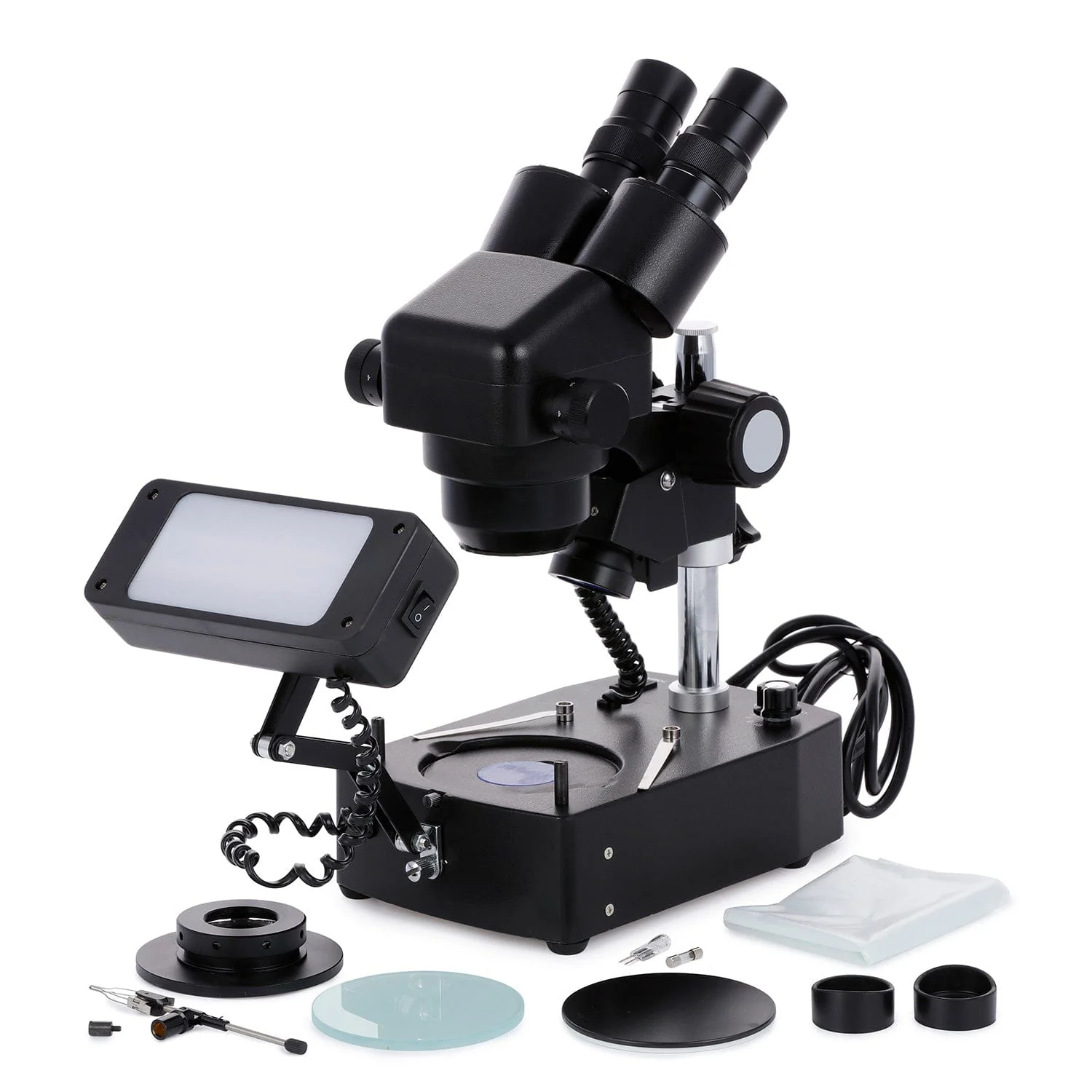
The microscope includes:
- gemstone-friendly illumination,
- a dedicated gem clamp,
- stereo viewing optics,
- darkfield observation capability,
- and a compact bench-friendly structure.
This is not a microscope primarily designed for biology classrooms or electronics repair benches. It is a purpose-built inspection tool for observing highly reflective and optically complex objects. That specialization matters. Gemstones behave differently from most observed objects because they interact intensely with light. Reflection, refraction, internal scattering, dispersion, and transparency all influence what the observer sees. A microscope optimized for gemology must therefore control illumination carefully.
Magnification Range: Why 10X to 40X Is Ideal for Jewelry Inspection
The SH-2 Series provides magnification from 10x to 40x. For beginners, these numbers may initially appear modest compared to biological microscopes advertising 1000x or more. However, gemological observation has very different requirements. In practical jewelry work, excessively high magnification often becomes counterproductive.
Higher magnification reduces:
- brightness,
- field of view,
- working distance,
- and viewing comfort.
Most gemstone analysis is performed comfortably within the 10x–40x range because it allows users to:
- inspect inclusions,
- study facet edges,
- observe polishing quality,
- identify chips,
- examine settings,
- and evaluate surface treatments
while still maintaining comfortable stereo depth perception. The 10x setting provides a broad overview suitable for examining entire stones and jewelry pieces, while 40x reveals much finer internal and surface detail. This magnification range is extremely practical for real-world jewelry applications.
Darkfield Illumination: One of the Most Important Gemological Features
One of the defining features of gemological microscopes is darkfield illumination. Darkfield lighting dramatically improves the visibility of inclusions and internal structures within transparent gemstones. Instead of illuminating the specimen directly from below, darkfield systems direct light at angles around the stone. This causes internal imperfections and structures to scatter light brightly against a dark background. The effect can be remarkable. Tiny inclusions that are nearly invisible under ordinary lighting suddenly become highly visible.
This technique is extremely valuable for:
- identifying natural inclusions,
- distinguishing synthetic stones,
- detecting fractures,
- examining clarity characteristics,
- and studying internal crystal growth structures.
The SH-2 Series includes integrated darkfield illumination specifically for this purpose. This immediately separates it from general-purpose stereo microscopes.
Understanding Gemstone Inclusions
One of the most fascinating aspects of gemology is the study of inclusions. Inclusions are tiny internal features trapped inside gemstones during formation. They may consist of:
- gas bubbles,
- mineral fragments,
- liquid pockets,
- crystal needles,
- fractures,
- or growth structures.
Interestingly, inclusions are not always undesirable. In fact, natural inclusions often help gemologists verify authenticity. Synthetic gemstones may appear “too perfect,” while natural stones typically contain microscopic imperfections formed over millions of years inside the Earth. Under stereo magnification, inclusions can become surprisingly beautiful. Some resemble tiny landscapes, clouds, feathers, fingerprints, or crystalline forests trapped inside the gem. This hidden microscopic world is one reason gemology becomes deeply fascinating for many collectors and jewelers.
Stereo Vision and Depth Perception
True stereo vision is especially important in jewelry inspection. Unlike flat digital microscope images, stereo microscopes create realistic depth perception. This helps users evaluate:
- prong settings,
- engraving depth,
- surface scratches,
- facet alignment,
- and three-dimensional gemstone geometry.
Depth perception also makes manipulation easier. Jewelry work often involves tweezers, tools, or cleaning instruments beneath the microscope. Stereo viewing allows users to judge distances naturally and comfortably. This is one reason many professional jewelers still strongly prefer optical stereo microscopes over cheaper digital inspection systems.
Illumination and Reflective Surfaces
Jewelry microscopy presents unique lighting challenges. Gemstones and polished metals are highly reflective. Poor illumination can easily create:
- glare,
- washed-out highlights,
- distracting reflections,
- or uneven brightness.
The SH-2 series is designed to manage these challenges more effectively than ordinary stereo microscopes.
Its illumination system helps reveal:
- surface texture,
- polishing quality,
- internal clarity,
- and structural details
without overwhelming the observer with excessive reflections. Controlled lighting is especially important when examining diamonds, highly polished gemstones, or reflective metal surfaces.
Jewelry Inspection Beyond Gemstones
Although gemstones are the microscope’s primary focus, the SH-2 Series is also highly useful for broader jewelry inspection tasks.
Users can examine:
- prong integrity,
- solder joints,
- engraving quality,
- watch mechanisms,
- chain links,
- hallmarks,
- metal wear,
- repair quality,
- and manufacturing defects.
For jewelers and repair technicians, this level of detailed inspection becomes essential. Tiny structural issues invisible to the naked eye can become obvious under stereo magnification. The microscope is also extremely useful during jewelry cleaning and restoration because users can monitor fine details safely during delicate work.
Ergonomics and Long Observation Sessions
Professional jewelry inspection often involves prolonged viewing sessions. Comfort therefore becomes critically important. The SH-2 Series uses a binocular stereo head with ergonomic viewing angles that reduce neck strain during extended observation. Interpupillary adjustment allows users to align the eyepieces comfortably with their eyes, while diopter adjustment compensates for minor vision differences between eyes. These may sound like small details, but they significantly improve long-term usability. Cheap microscopes often become uncomfortable surprisingly quickly. A properly adjusted stereo microscope feels far more natural and less fatiguing.
Build Quality and Professional Feel
One reason stereo microscopes remain popular in workshops is their mechanical simplicity and reliability. The SH-2 Series uses a stable metal support structure combined with practical focusing controls and durable optical components. Unlike many low-cost digital microscopes that feel more like electronic gadgets, a proper stereo microscope feels like a precision optical instrument. The focusing system allows smooth movement while maintaining stability during observation. This becomes especially important at higher magnifications where vibrations can interfere with detailed inspection.
The microscope’s compact footprint also makes it suitable for:
- jewelry workbenches,
- gemology labs,
- collector workspaces,
- and retail inspection environments.
Gemology, Science, and Human Fascination
One fascinating aspect of gemstone microscopy is how it combines science with beauty. Under magnification, gemstones become miniature geological worlds. Tiny fractures resemble frozen lightning. Mineral inclusions appear like microscopic landscapes. Crystal growth structures reveal millions of years of geological history trapped inside transparent minerals. For gemologists, the microscope is not merely an inspection tool. It becomes a window into the internal history of the stone itself. This combination of scientific analysis and aesthetic fascination is one reason gemology remains such a uniquely engaging field. Even experienced jewelers often continue discovering surprising details under magnification after many years of work.
Digital Microscopes vs Optical Stereo Microscopes
Modern users are often tempted by inexpensive digital microscopes with large advertised magnification numbers. However, for jewelry work, optical stereo microscopes still offer major advantages.
Digital microscopes often suffer from:
- screen lag,
- flat 2D imaging,
- reduced depth perception,
- poor dynamic range,
- and uncomfortable hand-eye coordination.
Stereo optical microscopes provide immediate real-time viewing with natural depth perception. For precision jewelry work, this difference is enormous. Digital systems certainly have their place, especially for photography and online sharing, but most serious jewelers and gemologists still strongly prefer optical stereo microscopes for direct observation and manipulation.
Who Is This Microscope For?
The AmScope SH-2 Series Jewelry Gem Stereo Microscope 10X-40X is especially suitable for:
- jewelers,
- gemologists,
- gemstone collectors,
- jewelry repair technicians,
- watchmakers,
- antique inspectors,
- pawn shops,
- educational gemology programs,
- mineral collectors,
- and precision inspection work.
It is also excellent for hobbyists interested in exploring the hidden microscopic beauty of gemstones and jewelry craftsmanship.
Final Verdict
The AmScope SH-2 Series Jewelry Gem Stereo Microscope successfully combines practicality, optical stereo viewing, and gemological specialization into a compact and highly usable instrument. Its strengths are not extreme magnification or research-laboratory complexity. Instead, its value comes from:
- realistic stereo depth perception,
- gemstone-optimized darkfield illumination,
- practical magnification,
- comfortable ergonomics,
- and hands-on usability.
Most importantly, it supports one of the most fascinating aspects of gemology:
the ability to explore the hidden internal worlds of gemstones — worlds shaped by geology, pressure, heat, time, craftsmanship, and light. For jewelers, collectors, gemologists, and enthusiasts alike, the microscope becomes far more than a magnifier. It becomes a bridge between science, craftsmanship, and the enduring human fascination with precious stones.


No Comments