

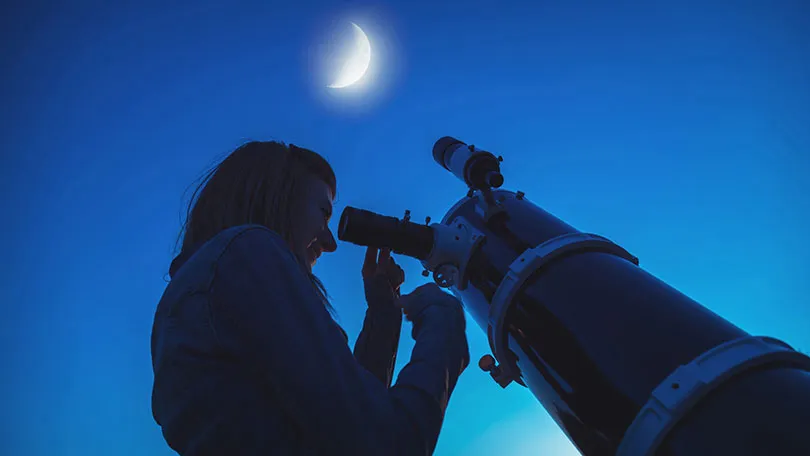
Deep-space observing is where amateur astronomy becomes truly emotional. The Moon is bright, planets are familiar, but galaxies, nebulae, and star clusters feel different. They are faint, distant, and sometimes difficult to capture, yet they are the objects that make many buyers say, This is why I wanted a telescope.
The challenge is that deep-sky targets do not reward the wrong equipment. A weak mount, a slow optical tube, or an oversized telescope that is too heavy to use can quickly turn excitement into frustration.
That is why choosing the best telescope for deep space is less about buying the biggest tube and more about choosing the right system for your goal. A visual observer needs aperture and comfort. An astrophotographer needs tracking accuracy, a suitable focal ratio, and a stable mount.
A beginner may need a smart telescope that can align, track, stack, and share images with very little setup. This guide gives you smart, practical picks based on how people actually use telescopes today: from backyard visual observing to serious imaging, from portable smart telescopes to powerful deep-sky rigs.
What Counts as Deep Space?
In amateur astronomy, deep space usually means deep-sky objects outside the solar system. These include galaxies, emission nebulae, reflection nebulae, planetary nebulae, globular clusters, and open star clusters. NASA notes that telescopes help reveal objects the eyes cannot detect, including brighter nebulae and galaxies, while dark locations make objects like the Milky Way and Andromeda easier to see with the naked eye or simple optics.
This matters because deep-sky observing is very different from planetary observing. Planets are bright and small. Many deep-sky objects are large but faint. For planets, long focal length and high magnification are useful. For deep-sky work, you often care more about light-gathering power, field of view, optical speed, and tracking.
If you want to understand why these features matter, it helps to first learn How Do Telescopes Work and how they collect, focus, and magnify light from distant objects.
Match the Telescope to the Job
Before choosing a model, ask one simple question: do you mainly want to look, photograph, or do both? Sky & Telescope recommends buyers think about what they most want to observe, how dark their sky is, how experienced they are, their budget, storage space, and how much weight they are willing to carry. It also helps to understand the main Types of Telescopes before deciding which design fits your needs.
For visual observing, aperture is king. A larger mirror collects more light, which helps reveal faint galaxies and nebulae. An 8-inch or 10-inch Dobsonian often gives excellent deep-sky views for the money.
For astrophotography, the mount becomes just as important as the telescope. Deep-sky imaging requires long exposure, accurate tracking, and a stable platform. A small high-quality refractor on a strong equatorial mount can produce better images than a huge telescope on a weak mount.
For easy modern imaging, smart telescopes are now a serious option. They are not traditional eyepiece instruments, but they make deep-sky imaging simple by combining optics, camera, mount, app control, live stacking, and object finding in one package.
Key Specs to Consider Before Buying
The important specifications are:
1. Aperture
Aperture is the diameter of the main lens or mirror. More aperture collects more light, which is helpful for faint deep-sky objects. However, bigger is not always better. Larger telescopes are heavier, need stronger mounts, and may be harder to transport. For visual deep-sky observing, 8 inches is a very strong starting point. For serious visual detail, 10 inches or more is even better.
2. Focal Ratio
Focal ratio tells you how fast a telescope is. For deep-sky photography, faster systems such as f/4, f/5, or f/5.5 collect light more efficiently and allow shorter exposures. PrimaLuceLab explains that lower focal ratios, especially around f/4 to f/6, are ideal for deep-sky astrophotography because they allow shorter exposures, while very long focal ratios are better suited to planets or small targets.
3. Focal Length
Short focal lengths give wider views. They are great for large nebulae, star fields, and wide galaxy groups. Long focal lengths give more magnification and are useful for smaller galaxies, planetary nebulae, and close-up imaging. A 250mm smart telescope is wide and easy. A 550mm APO refractor is excellent for many nebulae. A 2000mm SCT is powerful but more demanding.
4. Mount
For visual use, a Dobsonian mount is simple, stable, and affordable. For imaging, a German equatorial mount is usually the better choice because it tracks the rotation of the sky. The Sky-Watcher EQ6-R Pro, for example, offers a 44-pound payload capacity, built-in USB PC control, belt drives, autoguider compatibility, and reduced backlash, making it a popular class of mount for serious imaging systems.
5. Portability
A telescope that stays in storage is never the right telescope. If you live under light pollution, you may need to travel to darker skies. ESO explains that professional observatories are often built far from cities because light pollution affects astronomical observing. For amateurs, the same principle applies: a smaller telescope used often under darker skies can outperform a bigger telescope that is difficult to move.
Which Type Should You Choose?
| Telescope Type | Best For | Strengths | Limits |
|---|---|---|---|
| Dobsonian Reflector | Visual deep-sky observing | Big aperture, great value, simple use | Not ideal for long-exposure imaging |
| APO Refractor | Deep-sky imaging | Sharp stars, low maintenance, wide field | Smaller aperture for the price |
| Imaging Newtonian | Fast astrophotography | Large aperture, fast f-ratio, good value | Needs collimation and coma correction |
| SCT / EdgeHD | Versatile observing and imaging | Long focal length, compact tube | Demands a strong mount and guiding |
| Smart Telescope | Easy deep-sky imaging | App control, live stacking, beginner-friendly | Less flexible than traditional rigs |
Best Telescope for Deep Space
The best telescopes for deep space are:
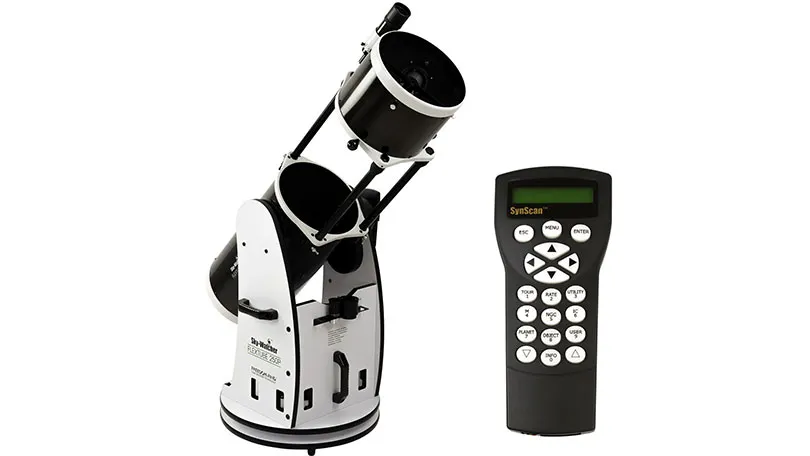
Sky-Watcher Flextube 250P Dobsonian: Best for Visual Deep-Sky Views
If your main goal is to see galaxies, nebulae, and clusters with your own eyes, a 10-inch Dobsonian is one of the smartest choices. The Sky-Watcher Flextube 250P gives you a 254mm aperture and 1200mm focal length in a collapsible design. Sky-Watcher describes it as suitable for visual observation of faint objects such as nebulae, star clusters, and galaxies, and notes that its 10-inch aperture collects far more light than the human eye.
This is not the most compact telescope, but it gives serious visual performance for the price. Under a dark sky, a 10-inch Dobsonian can show globular clusters with texture, brighter galaxies with shape, and nebulae with more presence than smaller instruments. It is also simple: no complex polar alignment, no laptop, no imaging software. You point, focus, and observe.
The Flextube design makes storage and transport easier than a full solid-tube Dobsonian. For buyers who want more aperture but still need practical handling, that is a real advantage.
- Best for: visual observers, dark-sky trips, galaxies, clusters, nebulae
- Not ideal for: serious long-exposure astrophotography
- Smart buying note: Add a good 2-inch wide-field eyepiece and a UHC filter for nebulae.
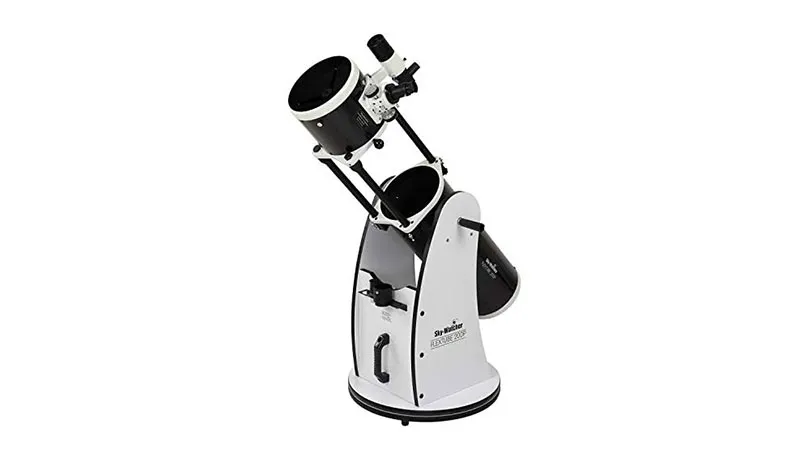
Sky-Watcher Classic 200P / Flextube 200P: Best Value Beginner Deep-Sky Telescope
An 8-inch Dobsonian is often the safest recommendation for a first serious telescope. It has enough aperture to make deep-sky observing exciting, but it is still easier to carry and store than a 10-inch or 12-inch model. Sky-Watcher lists the 200P class with a 203mm aperture and 1200mm focal length, and its Flextube 200P is described as suitable for faint objects such as nebulae, star clusters, and galaxies.
For beginners, this class gives a beautiful balance of cost, simplicity, and performance. You can learn the sky manually, practice star-hopping, and see many Messier objects from a reasonably dark location. In light-polluted cities, bright clusters, the Orion Nebula, the Moon, and planets will still be enjoyable, but galaxies will need darker skies.
- Best for: first serious telescope, visual astronomy, budget-conscious buyers
- Not ideal for: users who only want automatic object finding
- Smart buying note: Choose the GoTo SynScan version if you want help finding targets.
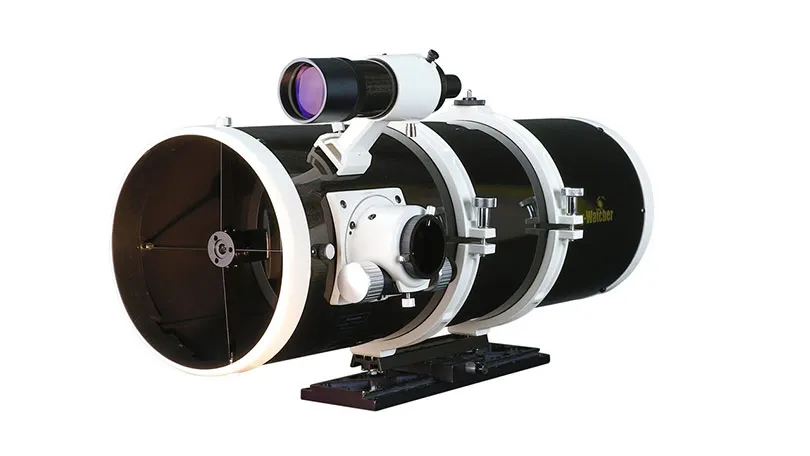
Sky-Watcher Quattro 200P Imaging Newtonian: Best Fast Imaging Newtonian
The Sky-Watcher Quattro 200P is a strong option for deep-sky photographers who want speed, aperture, and value. It has a 205mm aperture, 800mm focal length, and fast f/4 focal ratio. Sky-Watcher says it is designed as an imaging Newtonian with 94% reflective coatings, a dual-speed 2-inch Crayford-style focuser, and an oversized secondary mirror for better camera illumination.
This telescope can gather a lot of light quickly, which is valuable for nebulae, galaxies, and star clusters. Its 800mm focal length is also versatile: wide enough for many nebulae, but long enough for smaller galaxies compared with short refractors.
However, this is not a plug-and-play beginner imaging scope. A fast Newtonian needs accurate collimation. Most users should also plan for a coma corrector, a strong mount, and careful balancing. Put it on a weak mount, and you will fight tracking errors. Put it on an EQ6-R class mount, and it becomes a serious deep-sky tool.
- Best for: intermediate astrophotographers, fast imaging, good aperture per dollar
- Not ideal for: buyers who dislike collimation
- Smart buying note: Budget for a coma corrector and a strong equatorial mount.
Sky-Watcher Esprit 100ED APO Triplet: Best Premium Wide-Field Refractor
The Sky-Watcher Esprit 100ED is a favorite type of telescope for deep-sky imaging because it keeps things sharp, clean, and manageable. Sky-Watcher lists it as a 100mm apochromatic refractor with a 550mm focal length and f/5.5 focal ratio. If you want to understand why this optical design is popular for clean and sharp views, you can also read our guide to the refractor telescope.
This focal length is excellent for many popular targets: the North America Nebula, Rosette Nebula, Heart and Soul Nebula, Andromeda Galaxy, large star fields, and wide nebula regions. A 100mm APO will not collect as much light as an 8-inch Newtonian, but it is easier to mount, easier to guide, and easier to keep in optical alignment.
For many astrophotographers, the Esprit 100ED represents the point where imaging becomes less frustrating and more repeatable. It is not cheap, but it gives a clean path to high-quality results.
- Best for: wide-field astrophotography, clean stars, serious beginners to advanced users
- Not ideal for: visual-only buyers seeking maximum aperture
- Smart buying note: Pair it with a cooled astronomy camera or DSLR/mirrorless camera and an HEQ5/EQ6-class mount.
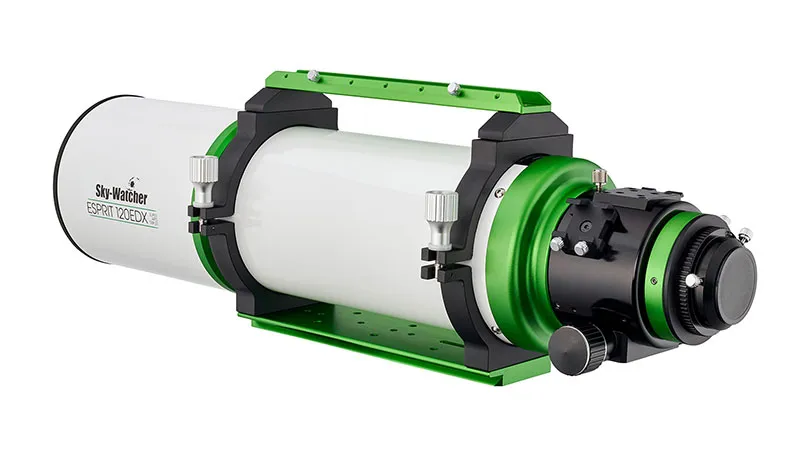
Sky-Watcher Esprit 120EDX: Best Larger APO Refractor for Serious Imaging
The Esprit 120EDX is for users who want more reach and more light than a 100mm refractor but still want the clean, low-maintenance behavior of an APO triplet. Sky-Watcher lists the 120EDX with a 120mm objective, 840mm focal length, f/7 focal ratio, a dual-speed 11:1 rack-and-pinion focuser, FPL-53 glass, and a rotatable focuser system for framing images.
This is a beautiful choice for smaller nebulae, galaxies, globular clusters, and tighter framing. The 840mm focal length gives more scale than a 550mm refractor, but it also asks more from the mount and guiding system. This is not the first telescope most beginners should buy, but it is an excellent upgrade for someone who already understands polar alignment, guiding, focusing, and image calibration.
- Best for: serious deep-sky imaging, sharper framing, galaxies, and nebulae
- Not ideal for: lightweight travel setups
- Smart buying note: Use a strong equatorial mount and pay attention to total payload after the camera, guide scope, filter wheel, and accessories.
Explore Scientific ED127 Essential Triplet: Best Value 5-Inch APO Refractor
The Explore Scientific ED127 Essential Triplet gives you a 127mm aperture, 952mm focal length, and f/7.5 focal ratio. Explore Scientific lists a limiting magnitude of 13, 0.9 arcsecond resolution, and an 18 lb tube weight.
This is a good option for buyers who want a larger refractor without moving into extremely expensive premium territory. The 127mm aperture gives better light gathering than smaller 80mm or 100mm refractors, and the near-1000mm focal length is useful for tighter deep-sky targets.
The tradeoff is weight and mount demand. Once you add camera gear, rings, guide scope, and accessories, you need a serious mount. For visual use, it gives crisp views, but for pure deep-sky visual observing, a Dobsonian still gives more aperture for the money.
- Best for: value-focused refractor imaging, serious hobbyists, medium-small targets
- Not ideal for: ultra-portable setups
- Smart buying note: Check the mount payload carefully before choosing this size.
Celestron EdgeHD 8: Best Versatile SCT for Visual and Imaging
The Celestron EdgeHD 8 is a strong choice for users who want one compact optical tube for many uses. Celestron lists the EdgeHD 8 with a 203.2mm aperture, 2032mm focal length, f/10 focal ratio, StarBright XLT coatings, and 14 lb optical tube weight.
For visual observing, the 8-inch aperture is very capable. You can observe globular clusters, planetary nebulae, brighter galaxies, the Moon, and planets. For imaging, the long focal length is better for smaller deep-sky objects than for large nebulae. It is also more demanding: guiding, focusing, and tracking must be precise.
EdgeHD optics are designed for a flatter field than standard SCTs, which matters for imaging. Celestron describes EdgeHD as an aplanatic flat-field Schmidt optical system made to produce pinpoint stars across the field.
- Best for: mixed visual and imaging, compact aperture, small galaxies
- Not ideal for: easiest beginner astrophotography
- Smart buying note: Consider a focal reducer if you want a faster and wider imaging setup.
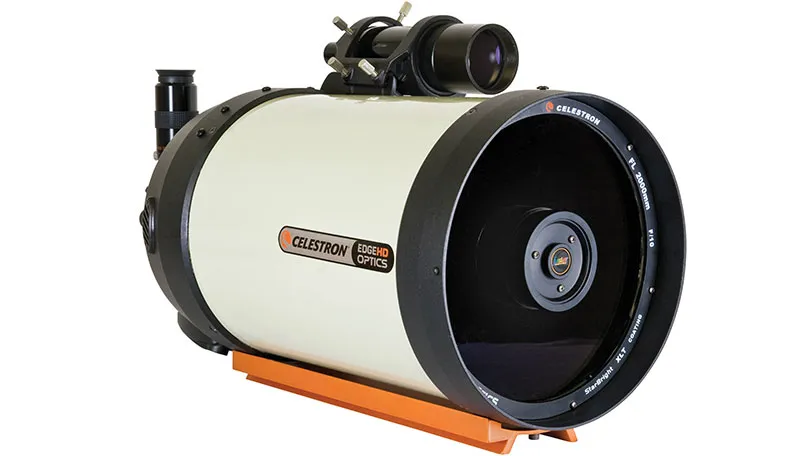
Celestron Origin Mark II: Best Premium Smart Deep-Sky System
The Celestron Origin Mark II is for buyers who want the simplest route to impressive deep-sky images without building a traditional rig. It uses a 6-inch RASA optical design with a fast f/2.2 focal ratio and a next-generation 678C camera using Sony Starvis 2 CMOS technology. Celestron says the system is designed to capture fine structure in galaxies, nebulae, and star clusters in near real time.
This is not a traditional telescope in the old sense. You are not buying it mainly for eyepiece viewing. You are buying an intelligent home observatory that combines optics, camera, mount, software, and live imaging. For many modern buyers, that is exactly the point. It reduces setup time and technical barriers.
- Best for: premium smart imaging, families, outreach, easy sharing
- Not ideal for: users who want traditional eyepiece observing
- Smart buying note: Choose it when convenience and fast results matter more than modular flexibility.
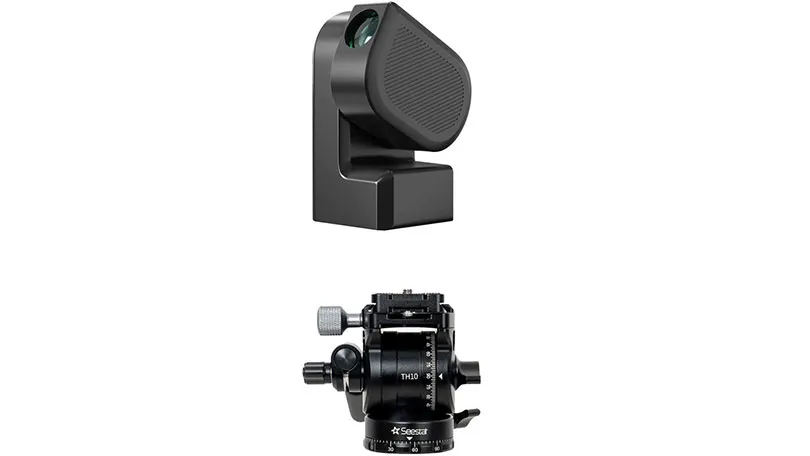
ZWO Seestar S50: Best Budget Smart Telescope
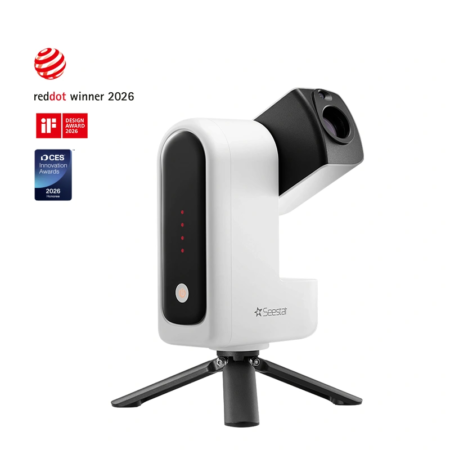
The ZWO Seestar S50 has become popular because it makes deep-sky imaging accessible. ZWO states that the S50 is a triplet APO with one ED glass element, f/5 focal ratio, 250mm focal length, app control, and about 6 hours of verified battery life under lab conditions.
Its 50mm aperture is small, so it will not replace a larger imaging rig. But it can automatically find, track, and stack deep-sky objects. That makes it attractive for beginners, travelers, and anyone who wants quick results without learning every technical step first.
The Seestar is especially good for large, bright nebulae, the Moon, star clusters, and casual galaxy imaging. It is also a fun educational tool because people can watch the image improve as the telescope stacks more light.
- Best for: beginners, travel, easy app-based imaging, budget-smart telescope buyers
- Not ideal for: high-resolution galaxy imaging or traditional visual use
- Smart buying note: Treat it as a smart imaging camera-telescope, not as a replacement for a large visual scope.
Vaonis Vespera II: Best Stylish Smart Telescope for Wide-Field Imaging
The Vaonis Vespera II is another strong smart telescope for users who want a polished app-based experience. Vaonis lists the Vespera II with a 50mm aperture, 250mm focal length, f/5 optics, Sony IMX585 color sensor, 8.3MP native image definition, and a 2.5° x 1.4° native field of view.
Its strength is wide-field deep-sky imaging. It is well suited to large nebulae, star fields, and mosaic-style captures. Like the Seestar, it is not built for high-magnification planetary work or traditional eyepiece observing. Its appeal is simplicity, design, and ease of sharing.
- Best for: stylish smart imaging, wide fields, simple setup
- Not ideal for: buyers needing large aperture or manual optical flexibility
- Smart buying note: Choose it if user experience and image-sharing matter as much as raw aperture.
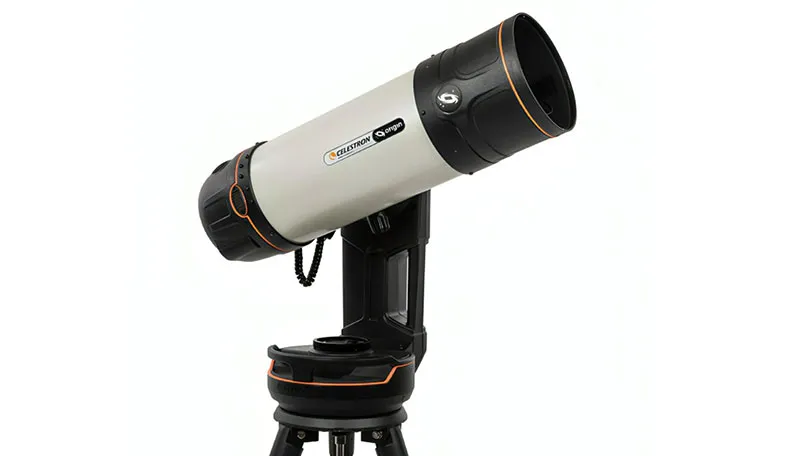
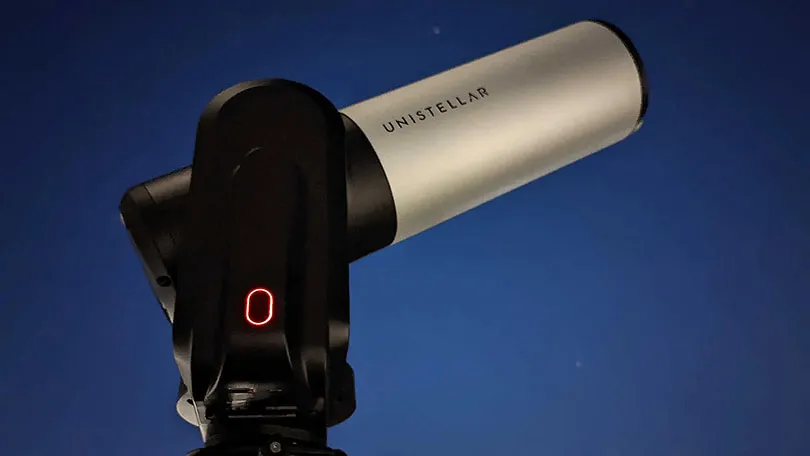
Unistellar eVscope 2: Best Premium Electronic Eyepiece Experience
The Unistellar eVscope 2 is a premium smart telescope with a different feel from most app-only systems. Unistellar lists it with a 114mm mirror, 450mm focal length, f/4 focal ratio, 7.7MP image resolution, motorized alt-az mount, 64GB storage, and 9-hour battery autonomy.
The key attraction is its electronic eyepiece experience and deep-sky ease. It gives users a more telescope-like feeling while still using digital enhancement. Its 114mm aperture is larger than that of many compact smart telescopes, which helps with faint objects.
- Best for: premium smart observing, outreach, electronic eyepiece viewing
- Not ideal for: budget buyers or fully modular astrophotography setups
- Smart buying note: Choose it if you want smart imaging with a more immersive observing style.
Best Telescope for Deep Space Astrophotography
The phrase best telescope for deep space astrophotography can be misleading because the telescope alone is not enough. A successful imaging system also needs the right optical tube, mount, camera, guiding solution, power setup, and software workflow.
Most beginners will get the safest results with a 70mm to 100mm APO refractor on a good equatorial mount. This type of setup is forgiving, sharp, and easier to guide. Intermediate users may prefer the Sky-Watcher Quattro 200P because it offers strong speed and aperture, although it also requires accurate collimation and a coma corrector.
Advanced users can choose the EdgeHD 8 for smaller galaxies and planetary nebulae, but it requires more precision in tracking, focusing, and guiding. Buyers who want almost no learning curve may prefer smart telescopes such as the Seestar S50, Vespera II, Unistellar eVscope 2, and Celestron Origin Mark II because they offer the fastest route to shareable deep-sky images.
Our Buying Advice for Customers
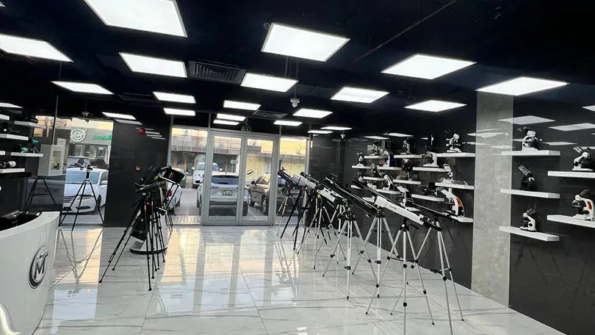
With 25 years of successful sales and service experience in Iran and 15 years of activity in Dubai, we understand that customers do not just need a telescope; they need the right telescope. In Iran, we are known through dubaitelescope.com, and in Dubai, we are known as Magic Shop.
Our goal is simple: to help you fill your observing and imaging needs with quality products that match your sky, budget, space, and experience level. Whether you want your first deep-sky view, your first galaxy photo, or a complete smart telescope system, we can guide you toward a setup that makes sense from the first night.
You can also explore our guide to Brands of Telescopes to better understand trusted telescope names before making your choice.
How to Choose Based on Your Situation
- If You Are a beginner, choose an 8-inch Dobsonian for visual observing. Choose a smart telescope for easy imaging. Choose a small APO refractor and an equatorial mount if you want to learn real astrophotography step by step. If you are still comparing simple first options, our guide to Best Telescopes for Beginners can help you choose a setup that matches your budget, space, and observing goals.
- If You Live in a city, light pollution makes faint galaxies and nebulae harder to see visually. A smart telescope or imaging setup can help because cameras collect and stack light over time. For visual use, focus on the Moon, planets, double stars, bright clusters, and brighter nebulae. Travel to darker skies when possible.
- If You Want the Best Value: For visual value, choose an 8-inch or 10-inch Dobsonian. For imaging value, choose a fast Newtonian like the Quattro 200P if you are ready for collimation. For simple modern value, choose the Seestar S50.
- If You Want Premium Results: For premium imaging, consider the Esprit 100ED, Esprit 120EDX, EdgeHD 8, or Celestron Origin Mark II, depending on whether you want a traditional rig or a smart system. Always spend enough on the mount. A strong mount protects your investment.
Common Mistakes to Avoid
- Buying Too Much Telescope Too Soon: A huge telescope may look impressive, but if it is too heavy or complicated, you will use it less. Start with something you can handle confidently.
- Ignoring the Mount: For astrophotography, the mount is not an accessory. It is the foundation. A good optical tube on a poor mount will disappoint you.
- Expecting Visual Views to Look Like Photos: Deep-sky objects often look faint and gray through an eyepiece. Cameras reveal color because they collect light over longer exposures. This is normal and does not mean the telescope is weak.
- Choosing Only by Magnification: Deep-space astronomy is not about maximum magnification. It is about light, contrast, field of view, tracking, and sky darkness.
- Forgetting Accessories: Eyepieces, filters, power supplies, dew control, field flatteners, coma correctors, adapters, cameras, and guide scopes can all matter. Always plan the full system, not only the optical tube.
Conclusion
For the strongest visual experience for the money, an 8-inch or 10-inch Dobsonian is one of the smartest choices. Buyers who want a clean and reliable imaging path should consider a 100mm APO refractor on a strong equatorial mount. For speed and aperture in deep-sky photography, a fast imaging Newtonian like the Sky-Watcher Quattro 200P can be an excellent option.
The EdgeHD 8 is a strong choice for compact power and versatility. For the easiest modern deep-sky imaging experience, smart telescopes such as the Seestar S50, Vaonis Vespera II, Unistellar eVscope 2, or Celestron Origin Mark II offer a simple and beginner-friendly path.
The right deep-space telescope is the one that matches your sky, your patience, your budget, and your real observing habits. Do not buy only for specifications. Buy for the nights you will actually spend under the stars.
FAQ
For visual observing, 8 inches is a strong starting point. A 10-inch telescope gives brighter views of galaxies, nebulae, and clusters. For imaging, even smaller refractors can work well if the mount and camera are good.
Yes. A Dobsonian is one of the best value choices for visual deep-sky observing because it offers a large aperture at a reasonable price.
Yes, but it depends on the system. A smart telescope can capture beginner-friendly galaxy images. A traditional setup needs a tracking mount, a camera, and proper alignment.
Not always. A smart telescope is better for easy imaging and sharing. A traditional telescope is better if you want eyepiece viewing, upgrades, and full control.
For traditional long-exposure imaging, yes, an equatorial mount is strongly recommended. Smart telescopes use built-in tracking and stacking to simplify the process.

No Comments