

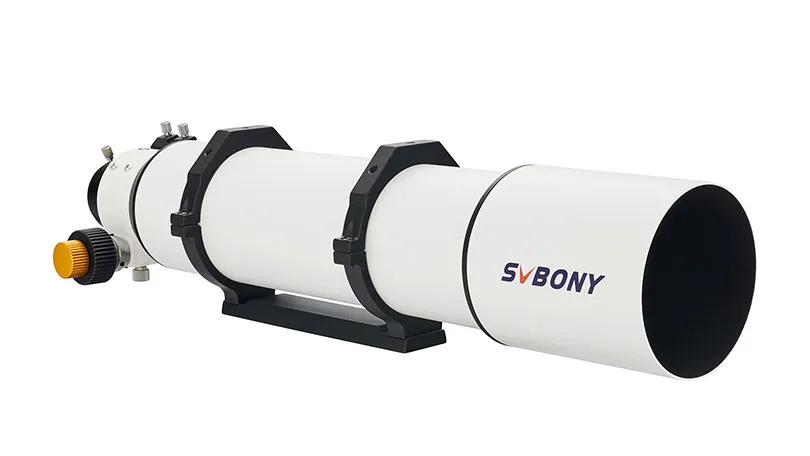
Looking up at the Moon for the first time through a telescope can turn an ordinary night into a moment of discovery. Yet for many new stargazers, choosing a telescope feels less magical: there are countless designs, sizes, mounts, and brands to compare. A Refractor Telescope for Beginners offers a simple and welcoming way to begin. Before making a choice, it also helps to understand the main Types of Telescopes, as each design has its own strengths for observing the Moon, planets, and deep-sky objects.
Using lenses to collect and focus light, it delivers crisp, bright views of the Moon, planets, and selected brighter deep-sky objects, usually with minimal setup and maintenance.
Refractor telescopes also have a special place in the history of astronomy. Early lens-based telescopes appeared in Europe in the early 1600s, and Galileo improved one of these designs in 1609 before using it to observe the sky and make groundbreaking discoveries.
Today’s refractors are far more advanced, but they still use the same basic idea: lenses bring distant light into focus and make the universe feel closer. In this guide, you will learn how refractor telescopes work, why they remain a popular choice for beginners, which features matter most, and how to choose the right model for family stargazing, a new astronomy hobby, or a meaningful gift.
What Is a Refractor Telescope?
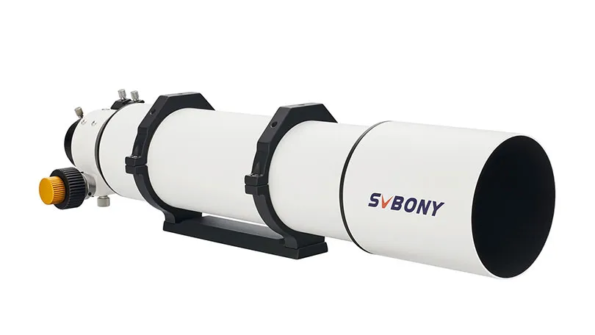
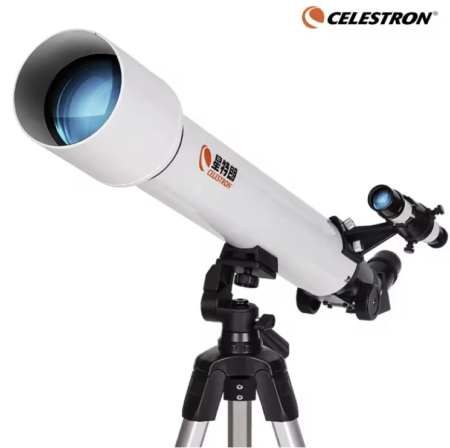
A refractor telescope uses glass lenses to collect and focus light. Unlike reflector telescopes that use mirrors, refractors rely on a front lens called the objective lens. This lens bends light and creates a clear image that you can view through the eyepiece.
Refractor telescopes are among the oldest telescope designs in history and remain one of the most popular choices for beginners today. They are easy to maintain, require very little adjustment, and usually provide crisp and high-contrast views.
When people search for a Refractor Telescope for Beginners, they are often looking for something simple, dependable, and ready to use without complicated setup procedures.
Main Components of a Refractor Telescope
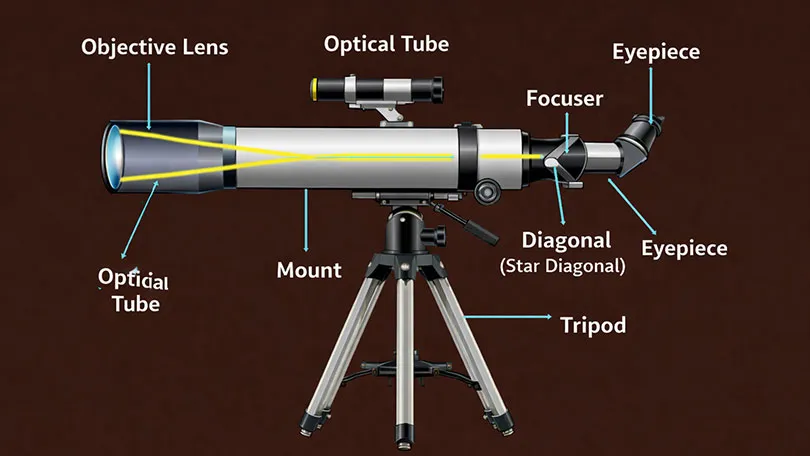
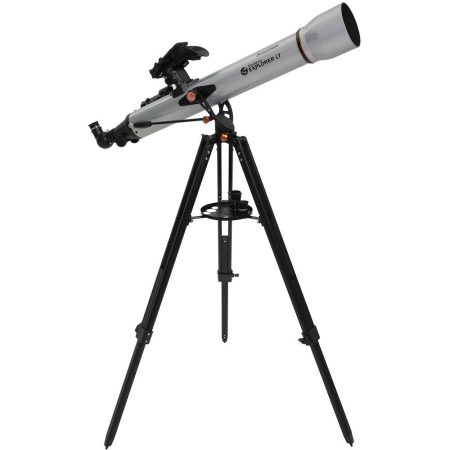
A refractor telescope is made up of several key parts that work together to collect light and produce a clear image of distant objects. Here are the main components:
- Objective Lens: The large front lens that gathers and focuses incoming light.
- Optical Tube: The main body that holds and aligns all optical components.
- Eyepiece: The lens you look through to magnify the image.
- Focuser: A mechanism used to adjust sharpness and bring the image into focus.
- Finder Scope: A small auxiliary scope that helps locate objects in the sky more easily.
- Mount: The support system that holds the telescope and allows smooth movement.
- Tripod: The three-legged stand that provides stability during observation.
- Diagonal (Star Diagonal): A mirror or prism that improves viewing comfort by bending the light path.
Why Refractor Telescopes Are Great for Beginners
Refractor telescopes are widely considered the gold standard for anyone dipping their toes into astronomy. If you are looking to explore the night sky without getting bogged down by technical complexity, the refractor design offers the most straightforward, user-friendly experience.
Here is a breakdown of why refractors are exceptionally well-suited for beginners:
1. Easy to Use
One of the biggest advantages of refractor telescopes is simplicity. Most models come almost fully assembled and can be ready for use within minutes. Beginners do not need to learn mirror alignment or advanced maintenance.
2. Sharp and Clear Images
Refractor telescopes are known for excellent image quality. They provide bright and detailed views of:
- The Moon
- Jupiter and its moons
- Saturn’s rings
- Venus phases
- Star clusters
- Bright nebulae
The image contrast is often better than that of many entry-level reflector telescopes.
3. Low Maintenance
Because the optical tube is sealed, dust and dirt are less likely to enter the telescope. This means less cleaning and fewer adjustments over time.
4. Great for Land and Sky Viewing
Many beginners also enjoy using their telescope during the daytime. Refractor telescopes can work well for viewing landscapes, wildlife, and distant objects.
How Does a Refractor Telescope Work?
A refractor telescope collects light through a large front lens. The light travels through the tube and focuses on the eyepiece. The eyepiece magnifies the image so your eye can see distant objects clearly.
The two most important specifications are:
Aperture
Aperture is the size of the main lens. A larger aperture gathers more light and shows more detail.
Examples:
- 70mm aperture = good beginner level
- 90mm aperture = brighter and sharper views
- 120mm+ aperture = more advanced viewing
Focal Length
Focal length affects magnification and field of view. Longer focal lengths are often better for planets and the Moon, while shorter focal lengths are better for wide sky views.
Types of Refractor Telescopes
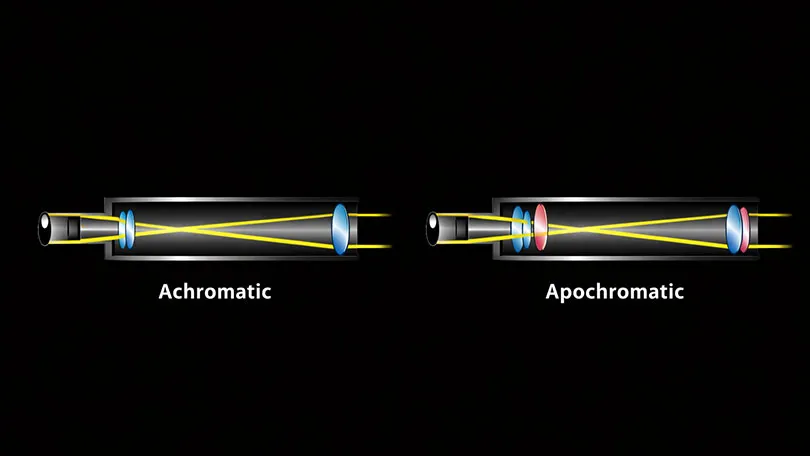
When exploring refractor telescopes, the classification primarily comes down to how the telescope handles chromatic aberration (color fringing). Because glass bends different colors of light at slightly different angles, a single lens cannot bring all colors to the same focal point.
To fix this, optical designers combine multiple lenses made from different types of glass. This divides refractors into two primary categories: Achromatic and Apochromatic.
While refractors are known for sharp and high-contrast views, some astronomy enthusiasts also compare them with Reflector Telescopes, which use mirrors instead of lenses and are often preferred for observing faint deep-sky objects with larger apertures.
Achromatic Refractors
These are more affordable and common for beginners. They provide good performance for casual astronomy.
Advantages:
- Budget-friendly
- Easy to use
- Good for the Moon and planets
Disadvantages:
- Some color fringing may appear around bright objects
Apochromatic Refractors
These use advanced lens designs for better color correction and sharper images.
Advantages:
- Excellent image quality
- Better astrophotography performance
Disadvantages:
- More expensive
For most beginners, an achromatic refractor is usually enough to start learning astronomy comfortably.
Achromatic and Apochromatic Refractor Telescopes
| Feature | Achromatic Refractors | Apochromatic Refractors |
|---|---|---|
| Lens Design | Uses a two-element lens system (doublet) | Uses an advanced multi-element lens system |
| Color Correction | Basic correction, some color fringing may appear | Excellent correction, almost no color fringing |
| Image Quality | Good for general viewing | Very sharp and high-contrast images |
| Best Use | Moon, planets, casual astronomy | Planets, deep-sky objects, astrophotography |
| Price | More affordable and budget-friendly | More expensive and premium |
| Beginner Friendly | Yes, very suitable for beginners | More suitable for advanced users or serious beginners |
| Maintenance | Simple and easy | Also, easy, but higher-end optics need more care |
| Overall Experience | Great entry-level experience | Professional-level viewing quality |
What Can You See With a Beginner Refractor Telescope?
A quality beginner refractor telescope can show many beautiful objects in the night sky. For example, modern space discoveries from instruments like the James Webb Space Telescope have helped us understand distant galaxies and deep space objects that inspire what we observe, even with beginner telescopes.
The Moon
You can see:
- Craters
- Mountains
- Lunar shadows
- Surface details
The Moon often looks incredibly sharp through a refractor telescope, and you can explore more options in Best Telescopes for Viewing Planets and Galaxies.
Planets
Jupiter
You may see:
- Cloud bands
- Four large moons
Saturn
You can clearly see:
- Rings
- Planet shape
Mars
During favorable conditions:
- Polar caps
- Surface color differences
Bright Deep-Sky Objects
A beginner refractor telescope can also show:
- Orion Nebula
- Pleiades star cluster
- Andromeda Galaxy
- Double stars
Important Features to Consider Before Buying
Here are the most critical features to evaluate before making a purchase:
1. Aperture Size
For beginners, 70mm to 102mm is usually a great range. Larger apertures collect more light but also increase price and weight.
2. Mount Type
Alt-Azimuth Mount
Simple up/down and left/right movement.
Best for:
- Beginners
- Casual viewing
Equatorial Mount
Designed for tracking celestial objects.
Best for:
- Advanced users
- Astrophotography
3. Portability
A lightweight telescope is easier to transport and use regularly.
4. Included Accessories
Good beginner packages may include:
- Eyepieces
- Finder scope
- Smartphone adapter
- Tripod
- Moon filter
Refractor Telescopes Popular Worldwide
The market for refractor telescopes has evolved significantly, with a handful of manufacturers and brands dominating the global landscape. These brands are often categorized by whether they focus on mass-market accessibility or high-end precision optics.
Here is an overview of the most popular refractor telescope brands found in the global market today:
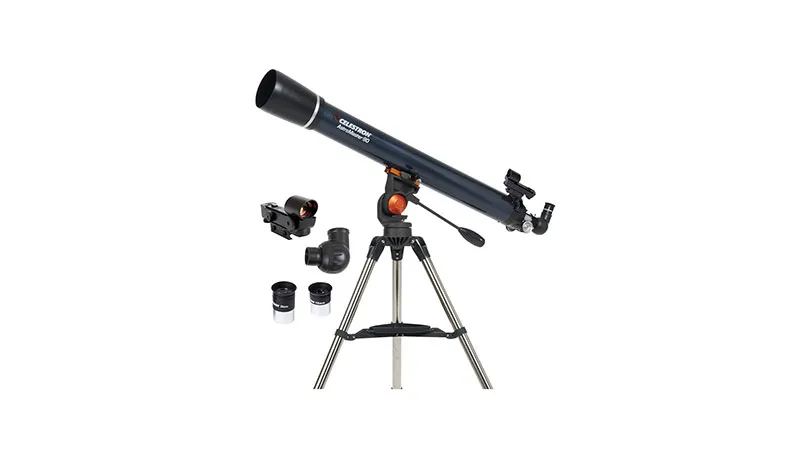
Celestron AstroMaster 90AZ
This telescope is popular because it combines simple operation with clear planetary viewing. The 90mm aperture provides bright images while remaining portable and beginner-friendly.
Best for:
- Moon observation
- Planet viewing
- Family astronomy
Sky-Watcher Evostar 80ED
The Sky-Watcher Evostar 80ED is one of the most popular refractor telescopes in its class, especially among serious beginners and amateur astrophotographers. One of its biggest advantages is the use of ED glass, which helps reduce chromatic aberration and produces sharper, cleaner images with better color correction.
This makes a noticeable difference when observing bright objects such as the Moon, planets, and stars, as well as when capturing deep-sky objects through astrophotography.
With its 80mm aperture, the Evostar 80ED collects enough light for detailed views while remaining compact and easy to handle. It is a great choice for users who want a telescope that can grow with them over time.
For visual astronomy, it delivers crisp and high-contrast views, while for imaging, it offers the optical quality needed for long-exposure deep-sky photography. Its solid build quality, reliable performance, and strong reputation make it a long-term investment for anyone who wants to move beyond basic beginner telescopes.
Best for:
- Serious beginners who want better optical quality
- Deep-sky astrophotography
- Moon, planet, and star cluster observation
- Long-term astronomy use
- Users looking for sharp images with reduced color fringing
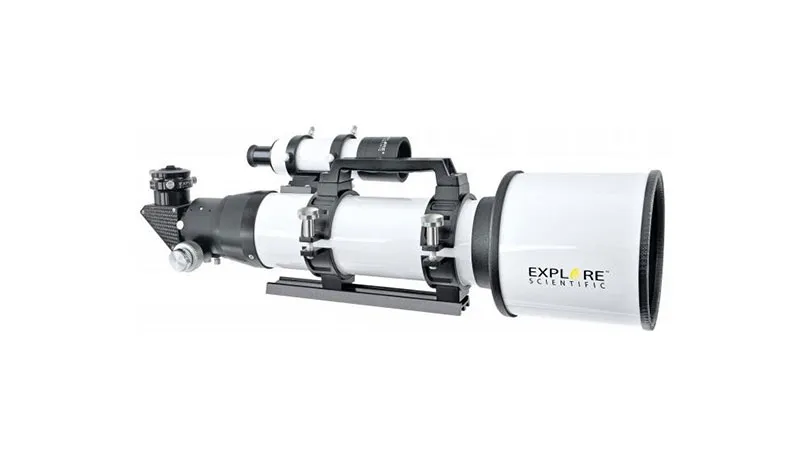
Explore Scientific AR102
The Explore Scientific AR102 is a powerful refractor telescope that offers bright and clear views while still being easy for many beginners to handle. Thanks to its larger 102mm aperture, it can show impressive details on planets like Jupiter and Saturn, and also works very well for viewing bright deep-sky objects such as star clusters and nebulae.
It is a great option for users who want better performance and sharper images without moving to a more complicated telescope system.
Recommended Refractor Telescopes From Our Collection
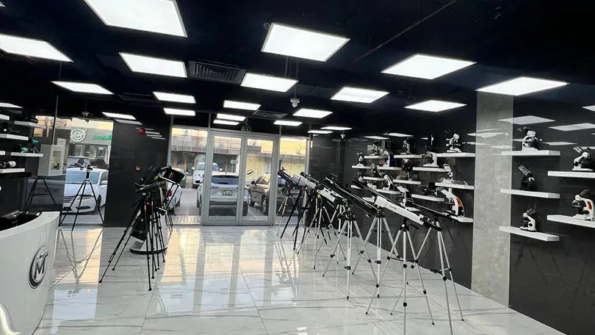
At Dubai Telescope, we carefully select practical and reliable telescopes that help beginners enjoy astronomy without unnecessary complexity. With over 25 years of experience in Iran and 15 years of active business in Dubai, we have helped thousands of astronomy enthusiasts find the right equipment for their needs.
Many customers know us through dubaitelescope.com in Iran and through Magic Shop in Dubai. Over the years, some well-known telescope lines from brands such as Orion and Meade have become discontinued or much harder to find, leaving many astronomy enthusiasts searching for reliable alternatives and replacement options.
Today, we help fill that gap by offering high-quality refractor telescopes and trusted products that provide excellent performance, dependable quality, and long-term value for both beginners and experienced users.
Sky-Watcher BK 707AZ2 Refractor Telescope
This telescope is one of the most beginner-friendly options available. It is lightweight, easy to set up, and excellent for Moon and planetary viewing.
Key advantages:
- Easy portability
- Smooth operation
- Clear optics
- Affordable price
Best for:
- Students
- Families
- First-time telescope users
Celestron PowerSeeker 80EQ
The PowerSeeker series remains highly popular because it offers good optical quality with a stable mount system.
Highlights:
- Good magnification options
- Strong beginner performance
- Equatorial tracking capability
Best for:
- Beginners wanting more control
- Learning sky tracking
Sky-Watcher StarTravel 102
This telescope offers a wider field of view and brighter images thanks to its larger aperture.
Advantages:
- Excellent wide-sky views
- Portable design
- Good for star clusters and nebulae
Best for:
- Deep-sky beginners
- Travel astronomy
Bresser Messier AR-90
This refractor provides a balanced mix of portability, quality optics, and beginner simplicity.
Features:
- Sharp planetary images
- Durable build quality
- Comfortable observing experience
Best for:
- Long-term beginner use
- Family stargazing
Our Suggestion: Refractor Telescopes Worth Considering
If you are looking for a reliable refractor telescope, these models from Dubai Telescope are worth checking out:
- ZWO FF130 APO Refractor Telescope: A premium APO refractor with a large 130mm aperture, ED glass elements, and a self-flattening optical design, making it a strong choice for serious astrophotography.
- Askar FRA600 108mm f/5.6 Petzval Astrograph: A high-quality Petzval refractor designed for wide-field deep-sky imaging, with a flat field and excellent color correction.
- Sky-Watcher Evostar 150DX Apo Refractor: A powerful apochromatic refractor for advanced users who want bright, detailed views and strong long-term performance.
- Sky-Watcher EvoStar 120ED Apo Refractor: A respected ED refractor that offers sharp, high-contrast views with reduced chromatic aberration.
- Sky-Watcher EvoStar 100ED Apo Refractor: A balanced choice for both visual astronomy and astrophotography, especially for users who want clean optics and better light transmission.
- William Optics Fluorostar 91 APO: A compact triplet apochromatic refractor with FPL-53 glass, suitable for sharp imaging and high-quality color correction.
- William Optics Gran Turismo 81 WIFD: A premium portable APO refractor designed for astrophotographers using modern cameras and heavier imaging setups.
- William Optics RedCat 71 WIFD APO 350mm f/4.9: A compact Petzval-style APO refractor that is excellent for wide-field astrophotography and clean star images.
- William Optics RedCat 51 II-U APO 250mm f/4.9: A small and travel-friendly apochromatic refractor, ideal for wide-field imaging with DSLR, mirrorless, or dedicated astronomy cameras.
- Celestron 63.5 ED Astronomical Telescope: A compact ED doublet refractor with reduced color fringing, smooth focusing, and a camera-friendly design for beginner to intermediate astrophotographers.
Tips for Using Your Refractor Telescope
- Let Your Eyes Adjust: Spend at least 15–20 minutes away from bright lights before observing.
- Start with the Moon: it's the easiest and most rewarding target for beginners.
- Use Low Magnification First: Begin with a low-power eyepiece to locate objects more easily.
- Choose Darker Locations: Less light pollution means better visibility.
- Be Patient: Astronomy improves with practice. The more you observe, the more details you will notice.
Common Mistakes Beginners Should Avoid
- Buying Based Only on Magnification: High magnification alone does not guarantee better viewing. Optical quality and aperture matter more.
- Ignoring Mount Stability: A shaky tripod can ruin the experience.
- Expecting NASA-Style Images: Visual astronomy looks different from edited space photos. Real observation is still beautiful and exciting.
- Choosing a Telescope That Is Too Complicated: A simple telescope used often is better than a complex telescope that stays in storage.
Is a Refractor Telescope Good for Astrophotography?
Yes, many refractor telescopes are excellent for beginner astrophotography.
They are especially good for:
- Moon photography
- Planetary imaging
- Wide-field star photography
Apochromatic refractors are preferred for advanced imaging because they reduce color distortion. However, even simple beginner refractors can produce beautiful images with smartphones and basic camera adapters.
Maintenance and Care
One of the advantages of refractor telescopes is that they are simple to maintain and usually require very little upkeep compared to other telescope types. To keep your telescope performing well, always place the lens cover back on after use to protect the optics from dust and dirt.
Store the telescope in a dry environment and avoid exposure to excessive moisture or sudden temperature changes, as humidity can degrade optical performance over time.
The lenses should only be cleaned when truly necessary, using proper lens-cleaning tools and soft microfiber cloths designed for optical equipment. Avoid touching the glass directly with your fingers and never use strong chemicals or rough materials, since they can damage the lens coating and reduce image quality.
Why Beginners Often Prefer Refractors Over Reflectors
Although reflector telescopes can provide larger apertures for lower prices, refractors remain highly popular because they are:
- Easier to operate
- Cleaner in appearance
- Lower maintenance
- Better for daytime viewing
- More beginner-friendly overall
For many people entering astronomy for the first time, simplicity creates a much more enjoyable learning experience. The best Refractor Telescope for Beginners is usually the one that encourages you to spend more time observing the sky instead of struggling with setup and adjustments.
Conclusion
Astronomy is one of the most rewarding hobbies you can begin, and choosing the right telescope makes a huge difference in your experience. A refractor telescope offers simplicity, reliability, and sharp image quality that helps beginners enjoy the night sky from the very first observation session.
Whether you want to explore the Moon’s craters, watch Saturn’s rings, or simply enjoy peaceful nights under the stars, a Refractor Telescope for Beginners can provide an enjoyable and frustration-free introduction to astronomy. By focusing on practical features like aperture, portability, mount quality, and ease of use, you can confidently choose a telescope that matches your goals and budget.
The sky is full of incredible objects waiting to be discovered. With the right refractor telescope, your astronomy journey can begin tonight.
FAQ
A 70mm to 90mm refractor telescope is usually ideal for most beginners.
Yes. Jupiter, Saturn, Venus, and Mars are excellent targets for beginner refractor telescopes.
No. They are one of the easiest telescope types to maintain and clean.
Yes. Refractor telescopes are simple to use, making them a great choice for families and young astronomy enthusiasts.

No Comments